中考
2023年辽宁省锦州中考数学
2023年辽宁省锦州中考数学,满分120分,考试时间120分钟,题型包括选择题、填空题,逐题解析,提供Word下载。
- 年份
- 2023
- 省市
- 辽宁
- 城市
- 锦州
- 科目
- 数学
- 类型
- 试卷
- 状态
- 精品
- 更新时间
- 2026-08-02
试卷信息与训练价值
- 考试年份
- 2023
- 考试地区
- 辽宁 · 锦州
- 考试类型
- 初中学业水平考试
- 科目
- 数学
- 满分
- 120 分
- 考试时间
- 120 分钟
- 题型
- 选择题、填空题
- 答案状态
- 答案完整
- 解析状态
- 逐题解析
- 文件格式
- Word
- 推荐完成时间
- 120 分钟
- 适合人群
- 九年级复习、中考真题训练
解析涉及的重点知识:了相反数的定义、了同底数幂的乘法、中位数、众数、了一元二次方程的定义及根的判别式、的是圆周角定理。
本卷多次涉及:三角形、函数、方程、圆、概率。
在线试题
2023年锦州市初中学业水平考试
数学试卷
考试时间 120 分钟
试卷满分 120 分
※考生注意:请在答题卡各题目规定答题区域内作答,答在本试卷上无效
一、选择题(本大题共 8道小题,每小题 2分,共 16分.在每小题给出的四个选项中,只有一项是符合题目要求的)
1. $2 0 2 3$ 的相反数是( ) A $\frac { 1 } { 2 0 2 3 }$
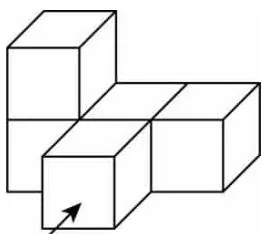
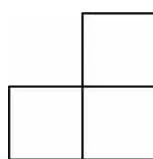
- 如图所示的几何体是由5个完全相同的小正方体搭成的,它的俯视图是( )
 正面
A.
B.
C.
D.
3. 下列运算正确的是( )
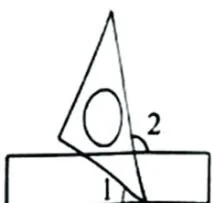
- 如图,将一个含 $4 5 ^ { \circ }$ 角的直角三角板按如图所示的位置摆放在直尺上.若 $\angle 1 = 2 8 ^ { \circ }$ ,则 $\angle 2$ 的度数为( )
A. $1 5 2 ^ { \circ }$ B. $1 3 5 ^ { \circ }$ C. $1 0 7 ^ { \circ }$ D. $7 3 ^ { \circ }$
- 在一次跳绳测试中,参与测试的10名学生一分钟跳绳成绩如下表所示:
| 成绩/次 | 129 | 130 | 132 | 135 | 137 |
| 人数/人 | 1 | 3 | 2 | 2 | 2 |
这 10 名学生跳绳成绩的中位数和众数分别为( )A 132,130 B. 132,132 C. 130,130 D. 130,132
6. 若关于x的一元二次方程 $k x ^ { 2 } - 2 x + 3 = 0$ 有两个实数根,则 k的取值范围是( )
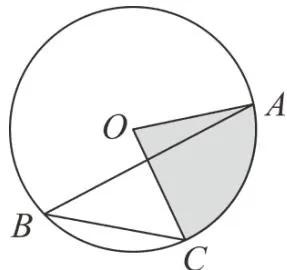
- 如图,点A,B,C在 上, $\angle A B C = 4 0 ^ { \circ }$ ,连接 , $O C$ .若 的半径为3,则扇形 (阴影部分)的面积为( )
A $\frac 2 3 \pi$ B. C. $\frac { 4 } { 3 } \pi$ D. $2 \pi$
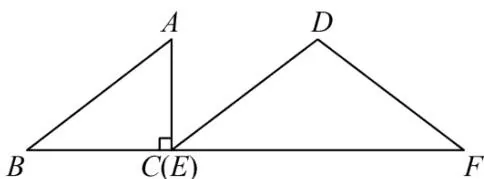
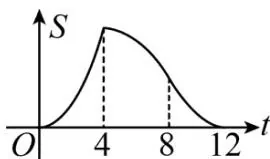
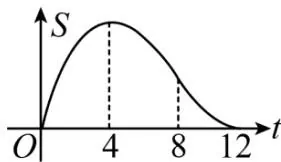
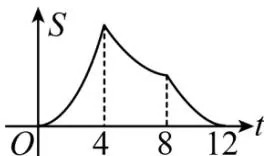
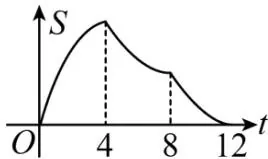
- 如图,在 $\mathrm { R t } \triangle A B C$ 中, $\angle A C B = 9 0 ^ { \circ }$ $A C = 3$ $B C = 4$ ,在 中, $D E = D F = 5$ $E F = 8$ 与 在同一条直线上,点 $C { \stackrel { \underset { \mathrm { E } } { } } { = } }$ 点E重合. 以每秒1个单位长度的速度沿线段 所在直线向右匀速运动,当点B运动到点F时, 停止运动.设运动时间为 t秒, 与 $\boxed { 1 } D E F$ 重叠部分的面积为 S,则下列图象能大致反映S与t之间函数关系的是( )
A.
B.
C.
D.
二、填空题(本大题共 8道小题,每小题 3分,共 24分)
近年来,跑步成为越来越多人的一种生活方式.据官方数据显示,2023年上海半程马拉松报名人数达到 78922人.将数据78922用科学记数法表示为
因式分解: $2 x ^ { 2 } - 4 x =$
甲、乙、丙三名运动员在5次射击训练中,平均成绩都是8.5环,方差分别是 $s _ { \mathrm { H } } ^ { 2 } = 0 . 7 8$ $s _ { \mathscr { Z } } ^ { 2 } = 0 . 2 0$ $s _ { \mathbb { H } } ^ { 2 } = 1 . 2 8$ ,则三名运动员中这5次训练成绩最稳定的是 _.(填“甲”或“乙”或$^ { 6 6 } \overrightarrow { P A } ^ { \prime 3 } )$
一个不透明的盒子中装有若干个红球和 个黑球,这些球除颜色外均相同.经多次摸球试验后发现,摸到黑球的频率稳定在 左右,则盒子中红球的个数约为
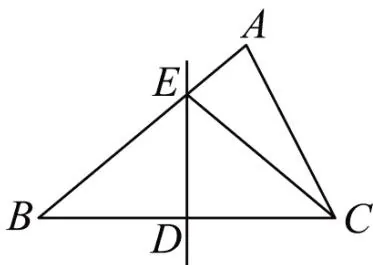
如图,在 中, 的垂直平分线交 于点D.交 AB于点E.连接 .若 $C E = C A$ $\angle A C E = 4 0 ^ { \circ }$ ,则 $\angle B$ 的度数为
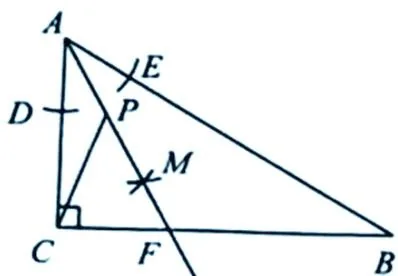
- 如图,在 $\mathrm { R t } \triangle A B C$ 中, $\angle A C B = 9 0 ^ { \circ }$ $\angle A B C = 3 0 ^ { \circ }$ $A C = 4$ ,按下列步骤作图:①在 和上分别截取 、 ,使 $A D = A E$ .②分别以点D和点E为圆心,以大于 $\cdot \frac { 1 } { 2 } D E$ 的长为半径作弧,两弧在 $\angle B A C$ 内交于点M.③作射线 交 于点F.若点P是线段 $A F$ 上的一个动点,连接 $C P$ ,则$C P + { \frac { 1 } { 2 } } A P$ 的最小值是
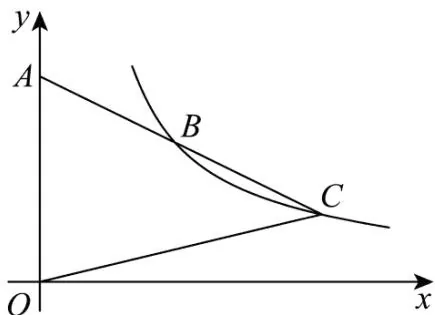
- 如图,在平面直角坐标系中, 的边 在y轴上,点C在第一象限内,点B为 的中点,反比例函数 $y = { \frac { k } { x } } { \big ( } x > 0 { \big ) }$ 的图象经过 B,C两点.若 的面积是 6,则 k的值为
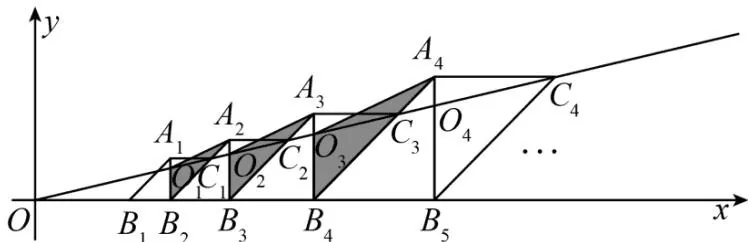
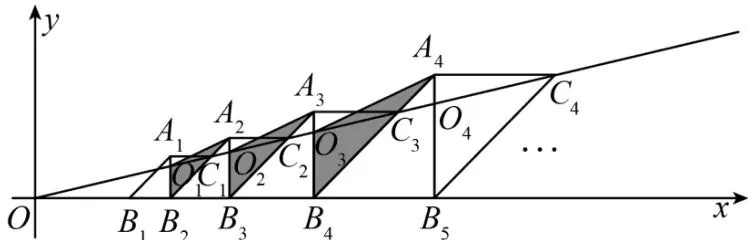
- 如图,在平面直角坐标系中,四边形 $A _ { 1 } B _ { 1 } B _ { 2 } C _ { 1 }$ $A _ { 2 } B _ { 2 } B _ { 3 } C _ { 2 }$ $A _ { 3 } B _ { 3 } B _ { 4 } C _ { 3 }$ $A _ { 4 } B _ { 4 } B _ { 5 } C _ { 4 }$ ,…都是平行四边形,顶点 $B _ { 1 } , ~ B _ { 2 } , ~ B _ { 3 } , ~ B _ { 4 } , ~ B _ { 5 }$ ,…都在x轴上,顶点 $C _ { 1 } , \ C _ { 2 } , \ C _ { 3 } , \ C _ { 4 }$ ,…都在正比例函数$y = \frac { 1 } { 4 } x ( x \geq 0 )$ 的图象上,且 $B _ { 2 } C _ { 1 } = 2 A _ { 2 } C _ { 1 }$ $B _ { 3 } C _ { 2 } = 2 A _ { 3 } C _ { 2 }$ $B _ { 4 } C _ { 3 } = 2 A _ { 4 } C _ { 3 }$ ,…,连接 $A _ { 1 } B _ { 2 }$ $A _ { 2 } B _ { 3 } , A _ { 3 } B _ { 4 } , A _ { 4 } B _ { 5 } , \cdots$ ,分别交射线 $O C _ { 1 }$ 于点 $O _ { 1 } , ~ O _ { 2 } , ~ O _ { 3 } , ~ O _ { 4 } , ~ \cdots$ ,连接 $O _ { 1 } A _ { 2 } \ : , \ : \ : O _ { 2 } A _ { 3 }$ $O _ { 3 } A _ { 4 } , \cdots$ ,得到 $\Delta O _ { 1 } A _ { 2 } B _ { 2 }$ $\Delta O _ { 2 } A _ { 3 } B _ { 3 }$ $\Delta O _ { 3 } A _ { 4 } B _ { 4 }$ ,….若 $B _ { 1 } ( 2 , 0 )$ $B _ { 2 } ( 3 , 0 )$ $A _ { \mathrm { l } } ( 3 , 1 )$ ,则$\Delta O _ { 2 0 2 3 } A _ { 2 0 2 4 } B _ { 2 0 2 4 }$ 的面积为
三、解答题(本大题共 2道题,第 17题 6分,第 18题 8分,共 14分)
化简,再求值: ${ \Biggl ( 1 + \frac { 1 } { a + 1 } \Biggr ) } \div \frac { a ^ { 2 } - 4 } { 2 a + 2 }$ ,其中 $a = 3$
2023年,教育部等八部门联合印发了《全国青少年学生读书先去实施方案》,某校为落实该方案,成立了四个主题阅读社团:A.民俗文化,B.节日文化,C.古曲诗词,D.红色经典.学校规定:每名学生必须参加且只能一个社团.学校随机对部分学生选择社团的情况进了调查.下面是根据调查结果绘制的两幅不完整的统计图
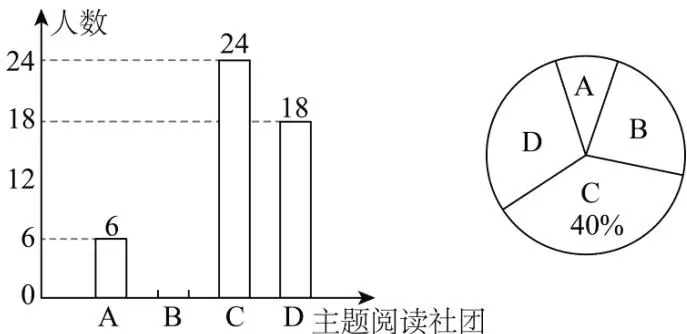
请根据图中提供的信息,解答下列问题:
(1)本次随机调查的学生有 名,在扇形统计图中“A”部分圆心角的度数为 ;
(2)通过计算补全条形统计图;
(3)若该校共有1800名学生,请根据以上调查结果,估计全校参加 $^ { 6 6 } D ^ { \prime \prime }$ 社团的人数
四、解答题(本大题共 2道题,每题 8分,共 16分)
- 垃圾分类工作是今年全国住房和城乡建设工作会议部署的重点工作之一.为营造人人参与垃圾分类的良好氛围,某市环保部门开展了“让垃圾分类成为低碳生活新时尚”宣传活动,决定从 A,B,C 三名志愿者中通过抽签的方式确定两名志愿者到社区进行垃圾分类知识宣讲,抽签规则:将三名志愿者的名字分别写在三张完全相同且不透明卡片的正面,把三张卡片背面朝上,洗匀后放在桌面上,先从中随机抽取一张卡片,记下名字,再从剩余的两张卡片中随机抽取第二张卡片,记下名字
(1)从三张卡片中随机抽取一张,恰好是“B志愿者”的概率是
(2)按照抽签规则,请你用列表法或画树状图法表示出两次抽签所有可能的结果,并求出A,B两名志愿者同时被抽中的概率
- 2023年5月15日,辽宁男篮取得第三次CBA总冠军,辽篮运动员的拼搏精神感染了众多球迷.某校篮球社团人数迅增,急需购进A,B两种品牌篮球,已知A品牌篮球单价比B品牌篮球单价的 2倍少48元,采购相同数量的 A,B两种品牌篮球,分别需要花费 9600元和 7200元.求A,B两种品牌篮球的单价分别是多少元?
五、解答题(本大题共 2 道题,每题 8 分,共 16 分)
- 如图1,是某校教学楼正厅一角处摆放的“教学楼平面示意图”展板,数学学习小组想要测量此展板的最高点到地面的高度.他们绘制了图2所示的展板侧面的截面图,并测得 $A B = 1 2 0 \mathrm { c m }$ $B D = 8 0 \mathrm { { c m } }$ $\angle A B D = 1 0 5 ^ { \circ }$ $\angle B D Q = 6 0 ^ { \circ }$ ,底座四边形 为矩形, $E F = 5 \mathrm { c m }$ .请帮助该数学学习小组求出展板最高点A到地面PF 的距离.(结果精确到 .参考数据: $\sqrt { 2 } \approx 1 . 4 1$ ${ \sqrt { 3 } } \approx 1 . 7 3 { \ } )$
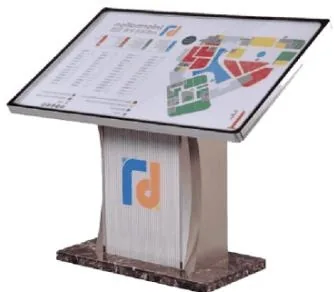
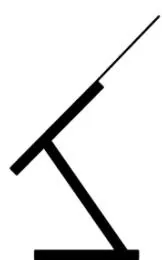 图1
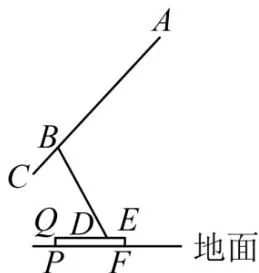 图2
- 如图, 为 直径,点C在 上, 与 O相切于点A,与 延长线交于点B,过点B作 $B D \bot O B$ ,交 的延长线于点 D
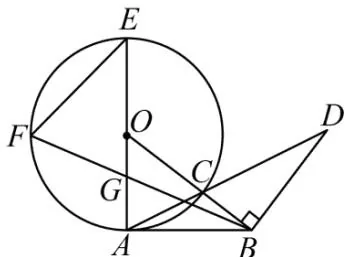
(1)求证: $A B = B D$
(2)点F为 上一点,连接 , $B F$ $B F$ 与 交于点G.若 $\angle E = 4 5 ^ { \circ }$ $A B = 5$
$\tan \angle A B G = \frac { 3 } { 7 }$ ,求 的半径及 的长
六、解答题(本题共 10 分)
- 端午节前夕,某批发部购入一批进价为8元/袋的粽子,销售过程中发现:日销量 y(袋)与售价x(元/袋)满足如图所示的一次函数关系
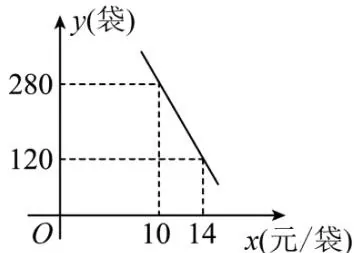
(1)求 y 与 x 之间的函数关系式;
(2)每袋粽子的售价定为多少元时,所获日销售利润最大,最大日销售利润是多少元?
七、解答题(本大题共 2 道题,每题 12 分,共 24 分)
- 【问题情境】如图,在 $A B C$ 中, $A B = A C$ $\angle A C B = \alpha$ .点D在边 上将线段 绕点D顺时针旋转得到线段 (旋转角小于 $1 8 0 ^ { \circ } ~ ,$ ),连接 , ,以 为底边在其上方作等腰三角形 ,使 $\angle F C E = \alpha$ ,连接 $A F$
【尝试探究】
(1)如图1,当 $\alpha = 6 0 ^ { \circ }$ 时,易知 $A F = B E$
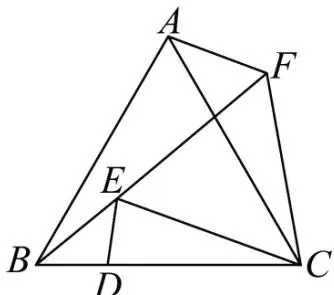 图1
如图 2,当 $\alpha = 4 5 ^ { \circ }$ 时,则 $A F$ 与 的数量关系为
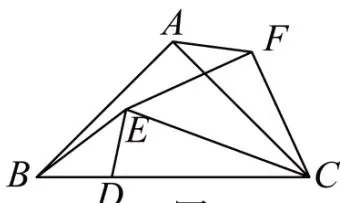 图2
(2)如图3,写出 与BE 的数量关系(用含α的三角函数表示).并说明理由;
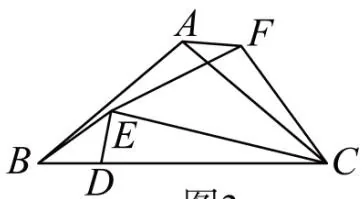 图3
【拓展应用】
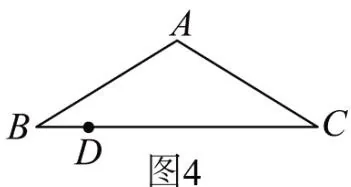
(3)如图4,当 $\alpha = 3 0 ^ { \circ }$ ,且点B,E,F三点共线时.若 $B C = 4 \sqrt { 7 }$ $B D = \frac { 1 } { 5 } B C$ ,请直接写出长.
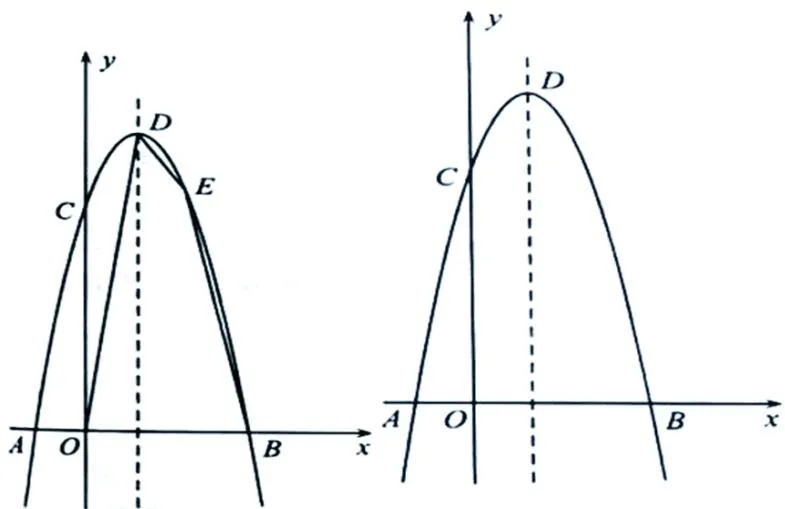
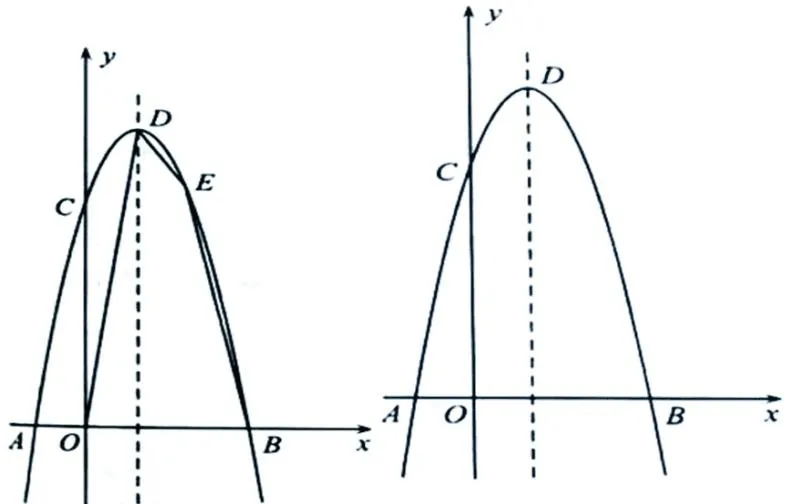
- 如图,抛物线 $y = - \sqrt { 3 } x ^ { 2 } + b x + c$ 交x轴于点 和 ,交 轴于点 $C \Big ( 0 , 3 \sqrt { 3 } \Big )$ ,顶点为
 备用图
(1)求抛物线的表达式;
(2)若点 在第一象限内对称右侧的抛物线上,四边形ODEB的面积为 $\phantom { - } 7 \sqrt { 3 }$ ,求点 的坐标;
(3)在(2)的条件下,若点 是对称轴上一点,点H 是坐标平面内一点,在对称轴右侧的抛物线上是否存在点 ,使以 , , ,H 为顶点的四边形是菱形,且 $\angle E F G = 6 0 ^ { \circ }$ ,如果存在,请直接写出点的坐标;如果不存在,请说明理由
答案与详细解析
2023年锦州市初中学业水平考试
数学试卷
考试时间 120 分钟 试卷满分 120 分
※考生注意:请在答题卡各题目规定答题区域内作答,答在本试卷上无效.
一、选择题(本大题共8道小题,每小题2分,共16分.在每小题给出的四个选项中,只有一项是符合题目要求的)
- 2023的相反数是() A. $\frac{1}{2023}$ B. -2023 C. 2023 D. $-\frac{1}{2023}$
【解析】
【分析】根据只有符号不同的两个数互为相反数进行解答即可得. 【详解】解:2023的相反数是-2023,
故选:B.
【点睛】本题考查了相反数的定义,熟练掌握相反数的定义是解题的关键.
- 如图所示的几何体是由 5 个完全相同的小正方体搭成的,它的俯视图是()
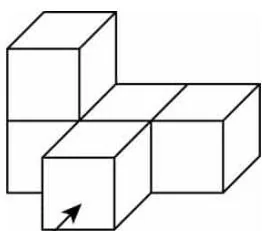
正面
A.
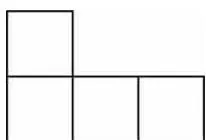
B.
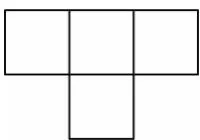
【答案】B
C.
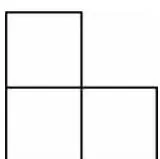
D.
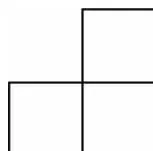
【解析】
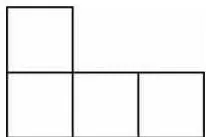
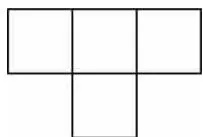
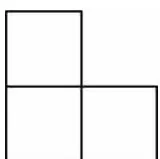
【分析】从上面看:共有3列,从左往右分别有1,2,1个小正方形,据此可画出图形.
【详解】解:如图所示的几何体的俯视图是:
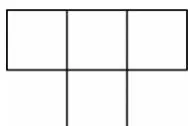
故选:B.
【点睛】此题主要考查了简单组合体的三视图;用到的知识点为:主视图,左视图,俯视图分别是从物体的正面,左面,上面看得到的图形.
- 下列运算正确的是() A. $a^{2} + a^{3} = a^{5}$ B. $a^{2} \cdot a^{3} = a^{5}$ C. $(a^{2})^{3} = a^{5}$ D. $(-2a^{2})^{3} = 6a^{6}$
【答案】B
【解析】
【分析】根据幂的运算法则判断选项的正确性即可.
【详解】对于 A, $a^{2}+a^{3}\neq a^{5}$ ,故 A 选项错误,
对于 B, $a^{2}\cdot a^{3}=a^{5}$ ,故 B 选项正确,
对于 C, $(a^{2})^{3}=a^{6}\neq a^{5}$ ,故 C 选项错误,
对于 D, $(-2a^{2})^{3}=-8a^{6}\neq6a^{6}$ ,故 D 选项错误,
故选:B.
【点睛】本题考查了同底数幂的乘法,幂的乘方和积的乘方,掌握相关运算法则是解答本题的关键.
- 如图,将一个含 $45^{\circ}$ 角的直角三角板按如图所示的位置摆放在直尺上.若 $\angle1=28^{\circ}$ ,则 $\angle2$ 的度数为()
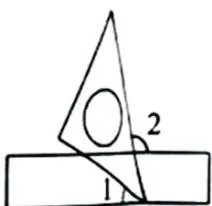
A. $152^{\circ}$ B. $135^{\circ}$ C. $107^{\circ}$ D. $73^{\circ}$
【答案】C
【解析】
【分析】由平角的定义可得 $\angle3=107^{\circ}$ ,由平行线的性质可得 $\angle2=\angle3=107^{\circ}$
【详解】如图,
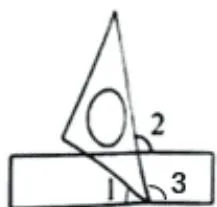
$\because \angle1=28^{\circ},$
$$ \therefore \angle 3 = 1 8 0 ^ {\circ} - 2 8 ^ {\circ} - 4 5 ^ {\circ} = 1 0 7 ^ {\circ} $$
∵直尺的对边平行,
$$ \therefore \angle 2 = \angle 3 = 1 0 7 ^ {\circ} $$
故选:C.
【点睛】本题主要考查平行线的性质,解答的关键是熟记平行线的性质:两直线平行,同位角相等. 5. 在一次跳绳测试中,参与测试的 10 名学生一分钟跳绳成绩如下表所示:
| 成绩/次 | 129 | 130 | 132 | 135 | 137 |
| 人数/人 | 1 | 3 | 2 | 2 | 2 |
这 10 名学生跳绳成绩的中位数和众数分别为() A. 132, 130 B. 132, 132 C. 130, 130 D. 130, 132
【答案】A
【解析】
【分析】中位数:是指将所有数从小到大或从大到小排列后,如果总数为奇数个,中位数就是排在最中间的那个数;如果总数为偶数个,中位数就是排在最中间的两个数的平均数;众数:一组数据中,出现次数最多的数据.根据定义即可求解. 【详解】解:这组数据的中位数为 $\frac{132+132}{2}=132$ , 这组数据中 130 出现次数最多,则众数为 130, 故选:A
故选:A.
【点睛】本题考查中位数、众数,熟知中位数、众数的计算方法,数据较大,正确计算是解答的关键.
- 若关于 x 的一元二次方程 $kx^{2}-2x+3=0$ 有两个实数根,则 k 的取值范围是() A. $k < \frac{1}{3}$ B. $k \leq \frac{1}{3}$ C. $k < \frac{1}{3}$ 且 $k \neq 0$ D. $k \leq \frac{1}{3}$ 且 $k \neq 0$
【答案】D
【解析】
【分析】根据一元二次方程的定义及根的判别式即可解答. 【详解】解:∵ $kx^{2}-2x+3=0$ 为一元二次方程,
$$ \therefore k \neq 0 $$
∵该一元二次方程有两个实数根, $\therefore \Delta=(-2)^{2}-4k\times3\geq0$
解得 $k \leq \frac{1}{3}$ , $\therefore k \leq \frac{1}{3}$ 且 $k \neq 0$ , 故选:D.
【点睛】本题考查了一元二次方程的定义及根的判别式,解题的关键是熟知当判别式的值大于0时,方程有两个不相等的实数根,同时要满足二次项的系数不能是0.
- 如图,点 A, B, C 在 □ O 上, $\angle ABC = 40^{\circ}$ ,连接 OA,OC.若 □ O 的半径为 3,则扇形 AOC(阴影部分)的面积为()
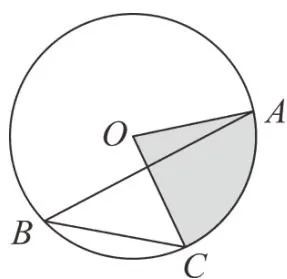
A. $\frac{2}{3}\pi$ B. $\pi$ C. $\frac{4}{3}\pi$ D. $2\pi$
【答案】D
【解析】
【分析】先利用圆周角定理求出 $\angle AOC$ 的度数,然后利用扇形面积公式求解即可.
$$ \because \angle A B C = 4 0 ^ {\circ} $$
$$ \therefore \angle A O C = 2 \angle A B C = 8 0 ^ {\circ} $$
又□O的半径为3,
∴扇形 AOC (阴影部分)的面积为 $\frac{80\pi \times 3^{2}}{360} = 2\pi$
故选:D.
【点睛】本题考查的是圆周角定理,扇形面积公式等,掌握“同弧所对的圆周角是它所对的圆心角的一半”是解题的关键.
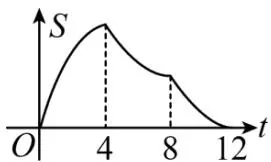
- 如图,在Rt△ABC中,∠ACB=90°,AC=3,BC=4,在□DEF中,DE=DF=5,EF=8,BC与EF在同一条直线上,点C与点E重合。□ABC以每秒1个单位长度的速度沿线段EF所在直线向右匀速运动,当点B运动到点F时,□ABC停止运动。设运动时间为t秒,□ABC与□DEF重叠部分的面积为S,则下列图象能大致反映S与t之间函数关系的是()
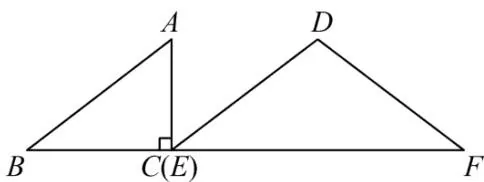
A.
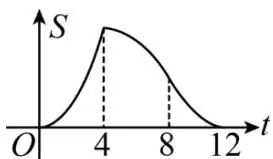
B.
C.
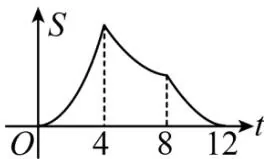
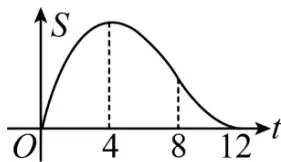
D.
【答案】A
【解析】
【分析】分 $0 \leq t < 4$ , $4 \leq t < 8$ , $8 \leq t < 12$ 三种情况,分别求出函数解析即可判断.
【详解】解:过点 D 作 $DH \perp CB$ 于 H,
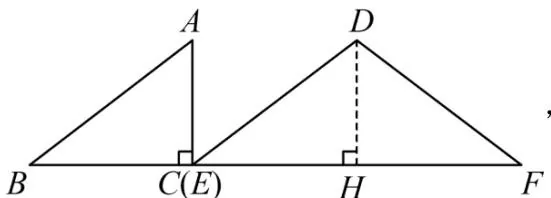
$\because DE = DF = 5,\quad EF = 8,$
$$ \therefore E H = F H = \frac {1}{2} E F = 4, $$
$$ \therefore D H = \sqrt {D E ^ {2} - E H ^ {2}} = 3 $$
当 $0 \leq t < 4$ 时,
如图,重叠部分为 $\triangle EPQ$ ,此时EQ=t, $PQ \parallel DH$ ,
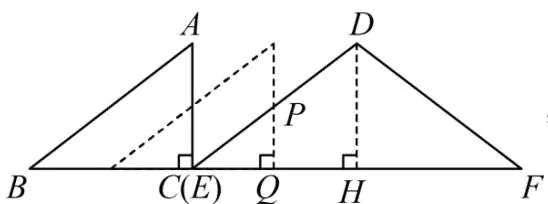
$\therefore \square EPQ \sim \square EDH$ ,
$\therefore \frac{PQ}{DH} = \frac{EQ}{EH}$ 即 $\frac{PQ}{3} = \frac{t}{4}$
$$ \therefore P Q = \frac {3}{4} t $$
$$ \therefore S = \frac {1}{2} t \times \frac {3}{4} t = \frac {3}{8} t ^ {2}; $$
当 $4 \leq t < 8$ 时,
如图,重叠部分为四边形 $PQC’B’$ ,此时 $BB’ = CC’ = t$ , $PB’ \parallel DE$ ,
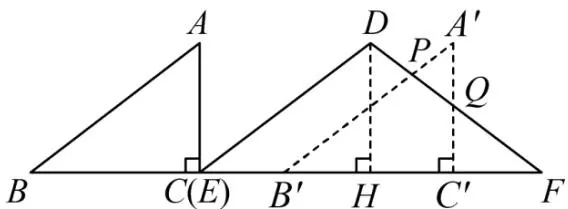
$\therefore B^{\prime}F = BC + CF - BB^{\prime} = 12 - t,\quad FC^{\prime} = 8 - t,$
$\because PB’ \parallel DE,$
$\therefore \square PB’F \sim \square DCF$ ,
$$ \therefore \frac {S _ {\square P B ^ {\prime} F}}{S _ {\square D C F}} = (\frac {B ^ {\prime} F}{C F}) ^ {2}, $$
又 $S_{\square DCF} = \frac{1}{2} \times 8 \times 3 = 12$
$\therefore \frac{S_{\square PB’F}}{12}=(\frac{12-t}{8})^{2},$
$\therefore S_{\square PB’F}=\frac{3}{16}(12-t)^{2},$
$$ \because D H \perp B C, \angle A ^ {\prime} B ^ {\prime} C ^ {\prime} = 9 0 ^ {\circ}, $$
$$ \therefore A ^ {\prime} C ^ {\prime} \parallel D H, $$
$$ \therefore \square C ^ {\prime} Q F \sim \square H F D, $$
$\therefore \frac{S_{\square C’QF}}{S_{\square HFD}} = (\frac{C’F}{HF})^2,$ 即 $\frac{S_{\square C’QF}}{\frac{1}{2}\times 4\times 3} = (\frac{8 - t}{4})^2,$
$$ \therefore S _ {\square C ^ {\prime} Q F} = \frac {3}{8} (8 - t) ^ {2}, $$
$$ \therefore S = S _ {\square P B ^ {\prime} F} - S _ {\square C ^ {\prime} Q F} = \frac {3}{1 6} (1 2 - t) ^ {2} - \frac {3}{8} (8 - t) ^ {2} = - \frac {3}{1 6} t ^ {2} + \frac {3}{2} t + 3; $$
当 $8 \leq t < 12$ 时
如图,重叠部分为四边形□PFB’,此时 $BB’=CC’=t$ , $PB’ \parallel DE$ ,
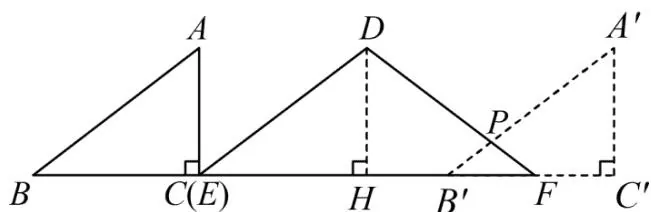
$\therefore B^{\prime}F = BC + CF - BB^{\prime} = 12 - t,$
$\because PB’ \parallel DE,$
$$ \therefore \square P B ^ {\prime} F \sim \square D C F $$
$\therefore \frac{S_{\square PB’F}}{S_{\square DCF}} = (\frac{B’F}{CF})^{2}$ ,即 $\frac{S_{\square PB’F}}{12} = (\frac{12 - t}{8})^{2}$
$$ \therefore S = S _ {\square P B ^ {\prime} F} = \frac {3}{1 6} (1 2 - t) ^ {2} $$
综上, $S=\begin{cases}\frac{3}{8}t^{2}(0\leq t<4)\-\frac{3}{16}t^{2}+\frac{3}{2}t+3(4\leq t<8),\ \frac{3}{16}(12-t)^{2}(8\leq t<12)\end{cases}$
∴符合题意的函数图象是选项 A.
故选:A.
【点睛】此题结合图像平移时面积的变化规律,考查二次函数相关知识,根据平移点的特点列出函数表达式是关键,有一定难度.
二、填空题(本大题共8道小题,每小题3分,共24分)
- 近年来,跑步成为越来越多人的一种生活方式.据官方数据显示,2023年上海半程马拉松报名人数达到78922人.将数据78922用科学记数法表示为____.
【答案】 $7.8922 \times 10^{4}$
【解析】
【分析】科学记数法的表示形式为 $a\times10^{n}$ 的形式,其中 $1\leq|a|<10$ ,n为整数.确定n的值时,要看把原数变成a时,小数点移动了多少位,n的绝对值与小数点移动的位数相同.当原数绝对值 $\geq10$ 时,n是正数;当原数的绝对值<1时,n是负数.
【详解】解: $78922 =
7.8922 \times 10^{4}$ ;
故答案为 $7.8922 \times 10^{4}$
【点睛】此题考查科学记数法的表示方法.科学记数法的表示形式为 $a\times10^{n}$ 的形式,其中 $1\leqslant|a|<10$ ,n为整数,表示时关键要正确确定a的值以及n的值.
- 因式分解: $2x^{2}-4x=$ ____.
【答案】 $2x(x-2)$
【解析】
【分析】直接提取公因式即可.
【详解】 $2x^{2}-4x=2x(x-2)$ .
故答案为: $2x(x-2)$ .
【点睛】本题考查了因式分解——提取公因式法,掌握知识点是解题关键.
- 甲、乙、丙三名运动员在 5 次射击训练中,平均成绩都是
8.5 环,方差分别是 $s_{甲}^{2}=0.78$ ,
$s_{乙}^{2}=0.20,\quad s_{丙}^{2}=1.28$ ,则三名运动员中这5次训练成绩最稳定的是____。(填“甲”或“乙”或“丙”)
【答案】乙
【解析】
【分析】根据方差越小,波动性越小,越稳定即可判断.
【详解】∵ $s_{甲}^{2}=0.78$ , $s_{乙}^{2}=0.20$ , $s_{丙}^{2}=1.28$ ,平均成绩都是8.5环,
$$ \therefore s _ {\text {乙}} ^ {2} < s _ {\text {甲}} ^ {2} < s _ {\text {丙}} ^ {2} $$
∴三名运动员中这5次训练成绩最稳定的是乙.
故答案为乙.
【点睛】本题考查方差.根据方差是反应一组数据的波动大小,方差越大,波动性越大,越不稳定.反之方差越小,波动性越小,越稳定是解答本题关键.
- 一个不透明的盒子中装有若干个红球和5个黑球,这些球除颜色外均相同。经多次摸球试验后发现,摸到黑球的频率稳定在0.25左右,则盒子中红球的个数约为____。
【答案】15
【解析】
【分析】设袋子中红球有 x 个,根据摸到黑球的频率稳定在
0.25 左右,可列出关于 x 的方程,求出 x 的值,从而得出结果.
【详解】解:设袋子中红球有x个,
根据题意,得 $\frac{5}{x+5}=0.25$ ,
$$ \therefore x = 1 5, $$
∴盒子中红球的个数约为15,
故答案为:15.
【点睛】本题主要考查了利用频率估计概率,熟练掌握求概率公式是解此题的关键.
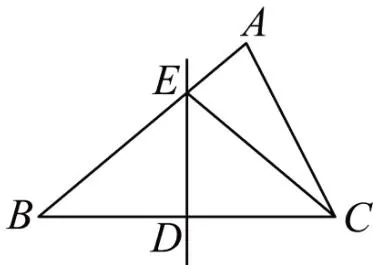
- 如图,在□ABC中,BC的垂直平分线交BC于点D.交AB于点E.连接CE.若CE=CA, $\angle ACE=40^{\circ}$ ,则 $\angle B$ 的度数为____.
【答案】35°##35度
【解析】
【分析】先在 $\triangle ACE$ 中利用等边对等角求出 $\angle AEC$ 的度数,然后根据垂直平分线的性质可得BE=CE,再利用等边对等角得出 $\angle B=\angle BCE$ ,最后结合三角形外角的性质即可求解.
【详解】解:∵ CE = CA,∠ACE = 40°,
$$ \therefore \angle A = \angle A E C = \frac {1 8 0 ^ {\circ} - \angle A C E}{2} = 7 0 ^ {\circ} $$
∵ DE 是 BC 的垂直平分线,
$$ \therefore B E = C E $$
$$ \therefore \angle B = \angle B C E $$
又 $\angle AEC = \angle B + \angle BCE$
$$ \therefore \angle B = 3 5 ^ {\circ} $$
故答案为: $35^{\circ}$ .
【点睛】本题考查了线段垂直平分线的性质,等腰三角形的性质,三角形外角的性质等知识,掌握等腰三角形的等边对等角是解题的关键.
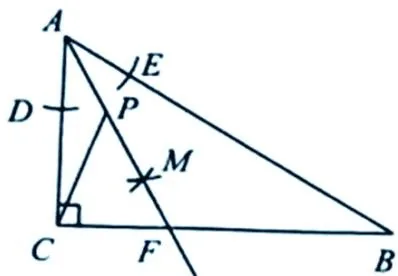
- 如图,在Rt△ABC中,∠ACB=90°,∠ABC=30°,AC=4,按下列步骤作图:①在AC和AB上分别截取AD、AE,使AD=AE.②分别以点D和点E为圆心,以大于 $\frac{1}{2}$ DE的长为半径作弧,两弧在∠BAC内交于点M.③作射线AM交BC于点F.若点P是线段AF上的一个动点,连接CP,则 $CP+\frac{1}{2}AP$ 的最小值是____.
【答案】 $2\sqrt{3}$
【解析】
【分析】过点 P 作 $PQ \perp AB$ 于点 Q,过点 C 作 $CH \perp AB$ 于点 H,先利用角平分线和三角形的内角和定理求出 $\angle BAF = 30^{\circ}$ ,然后利用含 $30^{\circ}$ 的直角三角的性质得出 $PQ = \frac{1}{2} AP$ ,则 $CP + \frac{1}{2} AP = CP + PQ \geq CH$ ,当 C、P、Q 三点共线,且与 AB 垂直时, $CP + \frac{1}{2} AP$ 最小, $CP + \frac{1}{2} AP$ 最小值为 CH,利用含 $30^{\circ}$ 的直角三角的性质和勾股定理求出 AB,BC,最后利用等面积法求解即可. 【详解】解:过点 P 作 $PQ \perp AB$ 于点 Q,过点 C 作 $CH \perp AB$ 于点 H,
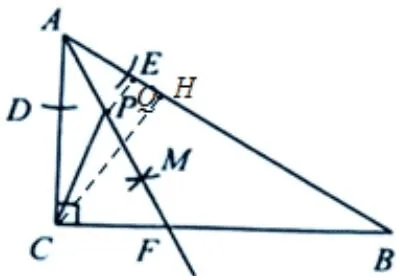
由题意知: $AF$ 平分 $\angle BAC$ , $\because \angle ACB = 90^{\circ},\angle ABC = 30^{\circ},$ $\therefore \angle BAC = 60^{\circ},$ $\therefore \angle BAF = \frac{1}{2}\angle BAC = 30^{\circ},$ $\therefore PQ = \frac{1}{2} AP,$ $\therefore CP + \frac{1}{2} AP = CP + PQ\geq CH$
∴当C、P、Q三点共线,且与AB垂直时, $CP+\frac{1}{2}AP$ 最小, $CP+\frac{1}{2}AP$ 最小值为CH, ∵ $\angle ACB = 90^{\circ}$ , $\angle ABC = 30^{\circ}$ ,AC = 4, ∴ AB = 2AC = 8,
$$ \therefore B C = \sqrt {A B ^ {2} - A C ^ {2}} = 4 \sqrt {3} $$
$$ \because S _ {\square A B C} = \frac {1}{2} A C \cdot B C = \frac {1}{2} A B \cdot C H , $$
$$ \therefore C H = \frac {A C \cdot B C}{A B} = \frac {4 \times 4 \sqrt {3}}{8} = 2 \sqrt {3}, $$
即 $CP + \frac{1}{2} AP$ 最小值为 $2\sqrt{3}$ .
故答案为: $2\sqrt{3}$ .
【点睛】本题考查了尺规作图-作角平分线,含 $30^{\circ}$ 的直角三角形的性质,勾股定理等知识,注意掌握利用等积法求三角形的高或点的线的距离的方法.
- 如图,在平面直角坐标系中,☐AOC 的边 OA 在 y 轴上,点 C 在第一象限内,点 B 为 AC 的中点,反比例函数 $y=\frac{k}{x}(x>0)$ 的图象经过 B,C 两点.若 ☐AOC 的面积是 6,则 k 的值为 ____.
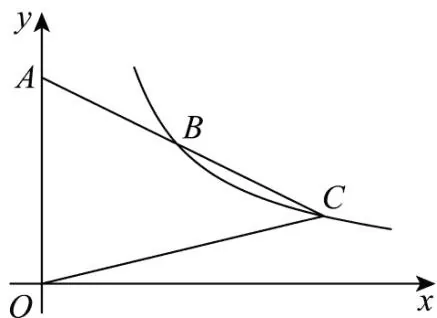 【答案】4
【解析】
【分析】过 B,C 两点分别作 y 轴的垂线,垂足分别为 D,E,设 B 点坐标为 $(m,\frac{k}{m})$ ,则 BD=m,由点 B 为 AC 的中点,推出 C 点坐标为 $(2m,\frac{k}{2m})$ ,求得直线 BC 的解析式,得到 A 点坐标,根据 □AOC 的面积是 6,列式计算即可求解.
【详解】解:过 B,C 两点分别作 y 轴的垂线,垂足分别为 D,E,∴ BD // CE, ∴ □ ABD ∼ □ ACE, ∴ $\frac{BD}{CE} = \frac{AB}{AC}$ , 设 B 点坐标为 $(m, \frac{k}{m})$ , 则 BD = m, ∵ 点 B 为 AC 的中点, ∴ $\frac{BD}{CE} = \frac{AB}{AC} = \frac{1}{2}$ , ∴ CE = 2BD = 2m, ∴ C 点坐标为 $(2m, \frac{k}{2m})$ , 设直线 BC 的解析式为 $y = ax + b$ , ∴ $\begin{cases} ma + b = \frac{k}{m} \ 2ma + b = \frac{k}{2m} \end{cases}$ , 解得 $\begin{cases} a = -\frac{k}{2m^2} \ b = \frac{3k}{2m} \end{cases}$ , ∴ 直线 BC 的解析式为 $y = -\frac{k}{2m^2}x + \frac{3k}{2m}$ , 当 $x = 0$ 时, $y = \frac{3k}{2m}$ , ∴ A 点坐标为 $(0, \frac{3k}{2m})$ , 根据题意得 $\frac{1}{2} \cdot \frac{3k}{2m} \cdot 2m = 6$ , 解得 $k = 4$ ,
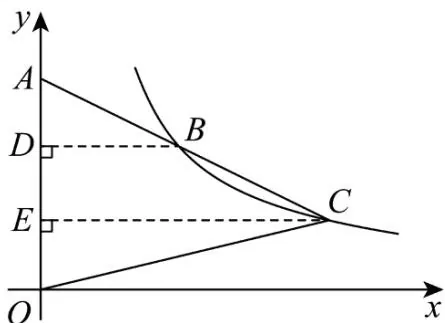
故答案为:4.
【点睛】本题考查了反比例函数 性质、相似三角形的判定及性质、求一次函数解析式、坐标与图形,解题关键是熟练掌握反比例函数的性质及相似三角形的性质.
- 如图,在平面直角坐标系中,四边形 $A_{1}B_{1}B_{2}C_{1}$ , $A_{2}B_{2}B_{3}C_{2}$ , $A_{3}B_{3}B_{4}C_{3}$ , $A_{4}B_{4}B_{5}C_{4}$ ,…都是平行四边形,顶点 $B_{1}$ , $B_{2}$ , $B_{3}$ , $B_{4}$ , $B_{5}$ ,…都在 x 轴上,顶点 $C_{1}$ , $C_{2}$ , $C_{3}$ , $C_{4}$ ,…都在正比例函数 $y=\frac{1}{4}x$ ( $x\geq0$ )的图象上,且 $B_{2}C_{1}=2A_{2}C_{1}$ , $B_{3}C_{2}=2A_{3}C_{2}$ , $B_{4}C_{3}=2A_{4}C_{3}$ ,…,连接 $A_{1}B_{2}$ , $A_{2}B_{3}$ , $A_{3}B_{4}$ , $A_{4}B_{5}$ ,…,分别交射线 $OC_{1}$ 于点 $O_{1}$ , $O_{2}$ , $O_{3}$ , $O_{4}$ ,…,连接 $O_{1}A_{2}$ , $O_{2}A_{3}$ ,
$O_{3}A_{4}$ ,…,得到 $\Delta O_{1}A_{2}B_{2}$ , $\Delta O_{2}A_{3}B_{3}$ , $\Delta O_{3}A_{4}B_{4}$ ,…。若 $B_{1}(2,0)$ , $B_{2}(3,0)$ , $A_{1}(3,1)$ ,则 $\Delta O_{2023}A_{2024}B_{2024}$ 的面积为____。
【答案】 $\frac{9^{2023}}{4^{2024}}$
【解析】
【分析】根据题意和图形可先求得 $\angle B_{2}B_{3}A_{2}=\angle B_{1}B_{2}A_{1}=90^{\circ}$ , $\angle B_{3}B_{4}A_{3}=\angle B_{2}B_{3}A_{2}=90^{\circ}$ ,
$$ \angle B _ {4} B _ {5} A _ {4} = \angle B _ {3} B _ {4} A _ {3} = 9 0 ^ {\circ}, \dots \dots , \angle B _ {n} B _ {n + 1} A _ {n} = \angle B _ {n - 1} B _ {n} A _ {n - 1} = 9 0 ^ {\circ}, B _ {3} (\frac {3}{2} \times 3, 0) B _ {4} ((\frac {3}{2}) ^ {2} \times 3, 0) $$
$B_{5}((\frac{3}{2})^{3}\times3,0),\quad\cdots\cdots,\quad B_{n}((\frac{3}{2})^{n-2}\times3,0),\quad$ 从而得 $B_{2024}((\frac{3}{2})^{2022}\times3,0),\quad B_{2025}((\frac{3}{2})^{2023}\times3,0),$
$B_{2024}B_{2025}=(\frac{3}{2})^{2023}\times3-(\frac{3}{2})^{2022}\times3=(\frac{3}{2})^{2023},\quad O_{2023}B_{2024}=n=\frac{1}{4}\times3\times(\frac{3}{2})^{2022}=\frac{3}{4}\times(\frac{3}{2})^{2022}$ ,利用三
【详解】解:∵ $B_{1}(2,0)$ , $B_{2}(3,0)$ , $A_{1}(3,1)$ ,
∴点 $A_{1}(3,1)$ 与点 $B_{2}(3,0)$ 的横坐标相同, $OB_{1}=2$ , $B_{1}B_{2}=3-2=1$ , $A_{1}B_{2}=1$ , $OB_{2}=3$ ,
$\therefore A_{1}B_{2}\perp x$ 轴,
$$ \therefore \angle A _ {1} B _ {2} O = 9 0 ^ {\circ}, $$
$$ \because B _ {2} C _ {1} = 2 A _ {2} C _ {1} $$
$$ \therefore \frac {B _ {2} C _ {1}}{A _ {2} C _ {1}} = 2, $$
∵四边形 $A_{1}B_{1}B_{2}C_{1}$ , $A_{2}B_{2}B_{3}C_{2}$ , $A_{3}B_{3}B_{4}C_{3}$ , $A_{4}B_{4}B_{5}C_{4}$ ,…都是平行四边形,
$$ \therefore A _ {1} B _ {1} / / A _ {2} B _ {2}, A _ {2} C _ {2} / / O B _ {2}, A _ {2} B _ {3} / / O B _ {3}, A _ {2} C _ {2} = B _ {2} B _ {3}, A _ {1} B _ {1} = B _ {2} C _ {1} $$
$\therefore \angle A_{1}B_{1}B_{2} = \angle A_{2}B_{2}B_{3}, \quad \angle C_{1}A_{2}C_{2} = \angle C_{1}B_{2}O, \quad \angle C_{1}C_{2}A_{2} = \angle C_{1}OB_{2}, \quad \frac{B_{2}A_{2}}{B_{1}A_{1}} = \frac{B_{2}A_{2}}{B_{2}C_{1}} = \frac{3}{2},$ $\therefore \nabla C_{1}C_{2}A_{2} \sim \angle C_{1}OB_{2},$ $\therefore \frac{OB_{2}}{C_{2}A_{2}} = \frac{C_{1}B_{2}}{C_{1}A_{2}} = \frac{OB_{2}}{B_{2}B_{3}} = 2,$ $\therefore B_{2}B_{3} = \frac{1}{2}OB_{2} = \frac{1}{2} \times 3,$ $\therefore \frac{B_{2}B_{3}}{B_{1}B_{2}} = \frac{3}{2} = \frac{B_{2}A_{2}}{B_{2}C_{1}}, \quad OB_{3} = \frac{3}{2}OB_{2} = \frac{3}{2} \times 3,$ $\therefore \square B_{2}B_{3}A_{2} \sim B_{1}B_{2}A_{1},$ $\therefore \angle B_{2}B_{3}A_{2} = \angle B_{1}B_{2}A_{1} = 90^{\circ},$ $\therefore B_{3}(\frac{3}{2} \times 3,0),$ 同理可得 $\angle B_{3}B_{4}A_{3} = \angle B_{2}B_{3}A_{2} = 90^{\circ}, \quad \angle B_{4}B_{5}A_{4} = \angle B_{3}B_{4}A_{3} = 90^{\circ}, \quad \cdots\cdots$ $\angle B_{n}B_{n+1}A_{n} = \angle B_{n-1}B_{n}A_{n-1} = 90^{\circ}, \quad B_{4}((\frac{3}{2})^{2} \times 3,0), \quad B_{5}((\frac{3}{2})^{3} \times 3,0), \quad \cdots\cdots, \quad B_{n}((\frac{3}{2})^{n-2} \times 3,0),$ $\therefore B_{2024}((\frac{3}{2})^{2022} \times 3,0), \quad B_{2025}((\frac{3}{2})^{2023} \times 3,0),$ $\therefore B_{2024}B_{2025} = (\frac{3}{2})^{2023} \times 3 - (\frac{3}{2})^{2022} \times 3 = (\frac{3}{2})^{2023},$ $\because O_{2023}((\frac{3}{2})^{2022} \times 3,n)$ 在 $y = \frac{1}{4}x$ 上, $\therefore O_{2023}B_{2024} = n = \frac{1}{4} \times 3 \times (\frac{3}{2})^{2022} = \frac{3}{4} \times (\frac{3}{2})^{2022},$ $\therefore S_{\square O_{2023}A_{2024}B_{2024}} = \frac{1}{2}B_{2024}B_{2025} \cdot O_{2023}A_{2024} = \frac{1}{2} \times (\frac{3}{2})^{2023} \times \frac{3}{4} \times (\frac{3}{2})^{2022} = \frac{3^{4046}}{2^{4048}} = \frac{9^{2023}}{4^{2024}},$ 故答案为: $\frac{9^{2023}}{4^{2024}}.$
【点睛】本题考查相似三角形的判定及性质,平行四边形的性质,坐标与图形,坐标规律,熟练掌握相似三角形的判定及性质以及平行四边形的性质是解题关键.
三、解答题(本大题共2道题,第17题6分,第18题8分,共14分)
- 化简,再求值: $(1+\frac{1}{a+1})\div\frac{a^{2}-4}{2a+2}$ ,其中a=3。
【答案】 $\frac{2}{a-2}$ ,2
【解析】
【分析】先把括号里的式子通分相减,然后把除数的分子、分母分解因式,再把除数分子分母颠倒后与前面的结果相乘,最后约成最简分式或整式;求值时把 a 值代入化简的式子算出结果.
【详解】解:原式 $= (\frac{a + 1}{a + 1} +\frac{1}{a + 1})\cdot \frac{2(a + 1)}{(a + 2)(a - 2)}$ $= \frac{a + 2}{a + 1}\cdot \frac{2(a + 1)}{(a + 2)(a - 2)}$ $= \frac{2}{a - 2}.$ 当 $a = 3$ 时,原式 $= \frac{2}{3 - 2} = 2$ :
【点睛】本题主要考查了分式的化简求值,熟练掌握分式的混合运算的顺序和运算法则,是解题的关键。 18. 2023 年,教育部等八部门联合印发了《全国青少年学生读书先去实施方案》,某校为落实该方案,成立了四个主题阅读社团:A.民俗文化,B.节日文化,C.古曲诗词,D.红色经典.学校规定:每名学生必须参加且只能一个社团.学校随机对部分学生选择社团的情况进了调查.下面是根据调查结果绘制的两幅不完整的统计图.
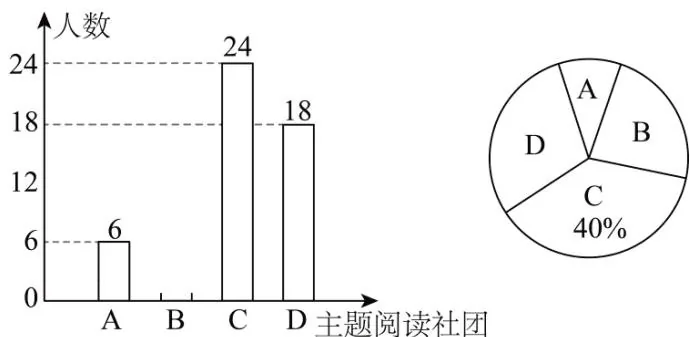
请根据图中提供的信息,解答下列问题:
(1)本次随机调查的学生有____名,在扇形统计图中“A”部分圆心角的度数为____;
(2)通过计算补全条形统计图;
(3)若该校共有 1800 名学生,请根据以上调查结果,估计全校参加 “D” 社团的人数.
【答案】(1)60,36°;
(2)见解析 (3)540名
【解析】
【分析】(1)由 C 组的人数及其所占百分比可得总人数,用 $360^{\circ}$ 乘以 A 人数所占比例即可得其对应圆心角度数;
(2)根据各类型人数之和等于总人数求得 B 组的人数,补全图形即可得;
(3)总人数乘以 D 组人数和所占比例即可.
【小问 1 详解】
本次调查的总人数 $24 \div 40% = 60$ (名),
扇形统计图中,C所对应的扇形的圆心角度数是 $360^{\circ}\times\frac{6}{60}=36^{\circ}$ ,
故答案为:60, $36^{\circ}$ ;
【小问 2 详解】
60-6-24-18=12(人);
补全条形统计图如答案图所示.
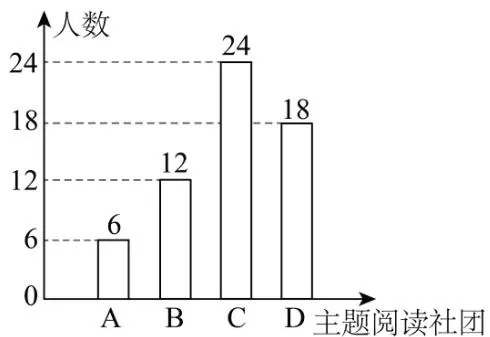
$1800 \times \frac{18}{60} = 540$ (名).
答:全校 1800 名学生中,参加 “D” 活动小组的学生约有 540 名.
【点睛】本题考查条形统计图、扇形统计图、用样本估计总体,解答本题的关键是明确题意,利用数形结合的思想解答.
四、解答题(本大题共2道题,每题8分,共16分)
- 垃圾分类工作是今年全国住房和城乡建设工作会议部署的重点工作之一.为营造人人参与垃圾分类的良好氛围,某市环保部门开展了“让垃圾分类成为低碳生活新时尚”宣传活动,决定从A,B,C三名志愿者中通过抽签的方式确定两名志愿者到社区进行垃圾分类知识宣讲,抽签规则:将三名志愿者的名字分别写在三张完全相同且不透明卡片的正面,把三张卡片背面朝上,洗匀后放在桌面上,先从中随机抽取一张卡片,记下名字,再从剩余的两张卡片中随机抽取第二张卡片,记下名字.
(1)从三张卡片中随机抽取一张,恰好是“B志愿者”的概率是____;
(2) 按照抽签规则, 请你用列表法或画树状图法表示出两次抽签所有可能的结果, 并求出 $A, B$ 两名志愿
者同时被抽中的概率.
【答案】(1) $\frac{1}{3}$
(2) $\frac{1}{3}$
【解析】
【分析】(1)从三张卡片中随机抽取一张,恰好是“B志愿者”的概率是 $\frac{1}{3}$ ;
(2)利用画树状图或列表法求概率即可.
【小问 1 详解】
解:从三张卡片中随机抽取一张,恰好是“B志愿者”的概率是 $\frac{1}{3}$ ,
故答案为: $\frac{1}{3}$ ;
【小问 2 详解】
解:方法一:根据题意可画树状图如下:
第一次
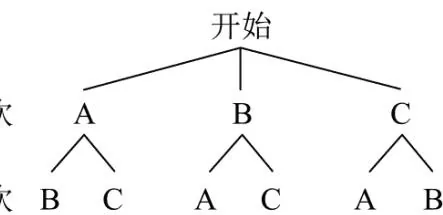
由树状图可知共有6种结果,每种结果出现的可能性相同,其中A,B两名志愿者同时被选中的有2种, $\therefore P(A, B \text{两名志愿者同时被选中}) = \frac{2}{6} = \frac{1}{3}$ .
方法二:根据题意可列表如下:
| A | B | C | |
| A | (A,B) | (A,C) | |
| B | (B,A) | (B,C) | |
| C | (C,A) | (C,B) |
由表格可知共有6种结果,每种结果出现的可能性相同,其中A,B两名志愿者同时被选中的有2种, $\therefore P(A, B \text{两名志愿者同时被选中}) = \frac{2}{6} = \frac{1}{3}$ .
【点睛】本题考查列表法和树状图法求概率,掌握概率的求法是解题的关键.
- 2023 年 5 月 15 日,辽宁男篮取得第三次 CBA 总冠军,辽篮运动员的拼搏精神感染了众多球迷.某校篮球社团人数迅增,急需购进 A,B 两种品牌篮球,已知 A 品牌篮球单价比 B 品牌篮球单价的 2 倍少 48元,采购相同数量的 A,B 两种品牌篮球,分别需要花费 9600 元和 7200 元.求 A,B 两种品牌篮球的单价分别是多少元?
【答案】A 品牌篮球单价为 96 元,B 品牌篮球单价为 72 元
【解析】
【分析】设 B 品牌篮球单价为 x 元,则 A 品牌篮球单价为 $(2x - 48)$ 元,,再利用 “采购相同数量的 A,B 两种品牌篮球,分别需要花费 9600 元和 7200 元”,列方程,解方程即可.
【详解】解:设 B 品牌篮球单价为 x 元,则 A 品牌篮球单价为 $(2x - 48)$ 元,
根据题意,得 $\frac{9600}{2x-48}=\frac{7200}{x}$ .
解这个方程,得 x = 72 .
经检验,x=72 是所列方程的根.
$$ 2 \times 7 2 - 4 8 = 9 6 \text {(元)}. $$
所以,A 品牌篮球单价为 96 元,B 品牌篮球单价为 72 元.
【点睛】本题考查的是分式方程的应用,设出恰当的未知数,确定相等关系是解题的关键.
五、解答题(本大题共2道题,每题8分,共16分)
- 如图 1,是某校教学楼正厅一角处摆放的“教学楼平面示意图”展板,数学学习小组想要测量此展板的最高点到地面的高度。他们绘制了图 2 所示的展板侧面的截面图,并测得 $AB = 120\mathrm{cm}$ ,
$BD=80cm,\quad\angle ABD=105^{\circ},\quad\angle BDQ=60^{\circ}$ ,底座四边形EFPQ为矩形, $EF=5cm$ .请帮助该数学 学习小组求出展板最高点 A 到地面 PF 的距离。(结果精确到 $1 , cm$ .参考数据: $\sqrt{2} \approx
1.41$ , $\sqrt{3} \approx
1.73$ )
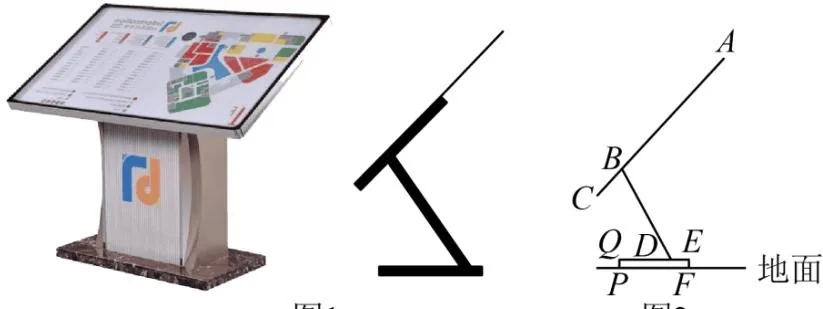 图1
图2
【答案】159cm
【解析】
【分析】过点 A 作 $AG \perp PF$ 于点 G,与直线 QE 交于点 H,过点 B 作 $BM \perp AG$ 于点 M,过点 D 作 $DN \perp BM$ 于点 N,分别解作出的直角三角形即可解答.
【详解】解:如图,过点 A 作 $AG \perp PF$ 于点 G,与直线 QE 交于点 H,过点 B 作 $BM \perp AG$ 于点 M,过点 D 作 $DN \perp BM$ 于点 N,
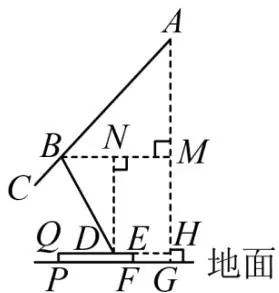
∴四边形 DHMN,四边形 EFGH 均为矩形,
$\therefore MH = ND, EF = HG = 5, BM \parallel DH,$
$$ \therefore \angle N B D = \angle B D Q = 6 0 ^ {\circ} $$
$$ \therefore \angle A B M = \angle A B D - \angle N B D = 1 0 5 ^ {\circ} - 6 0 ^ {\circ} = 4 5 ^ {\circ} $$
在 Rt□ABM 中, $\angle AMB = 90^{\circ}$ ,
$$ \because \sin \angle A B M = \sin 4 5 ^ {\circ} = \frac {A M}{A B}, $$
$$ \therefore A M = A B \cdot \sin 4 5 ^ {\circ} = 1 2 0 \times \frac {\sqrt {2}}{2} = 6 0 \sqrt {2}, $$
Rt△BDN 中,∠BND = 90°,
$$ \because \sin \angle N B D = \sin 6 0 ^ {\circ} = \frac {N D}{B D}, $$
$$ \therefore N D = B D \cdot \sin 6 0 ^ {\circ} = 8 0 \times \frac {\sqrt {3}}{2} = 4 0 \sqrt {3}, $$
$$ \therefore M H = N D = 4 0 \sqrt {3}, $$
$$ \therefore A G = A M + M H + G H = 6 0 \sqrt {2} + 4 0 \sqrt {3} + 5 \approx 6 0 \times
4 1 + 4 0 \times
7 3 + 5 \approx 1 5 9 (\mathrm{cm}),
$$
答: 展板最高点 A 到地面 PF 的距离为 159cm.
【点睛】本题考查解直角三角形的应用,正确作出辅助线构造出直角三角形,熟练通过解直角三角形求相应未知量是解题的关键.
- 如图,AE 为 □ O 的直径,点 C 在 □ O 上,AB 与 □ O 相切于点 A,与 OC 延长线交于点 B,过点 B 作 BD ⊥ OB,交 AC 的延长线于点 D.
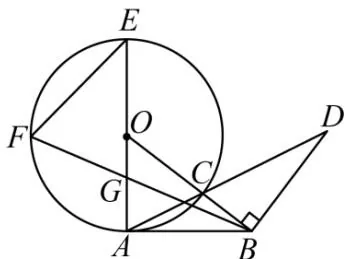
(1)求证:AB = BD;
(2)点 F 为 □ O 上一点,连接 EF,BF,BF 与 AE 交于点 G.若 $\angle E = 45^{\circ}$ ,AB = 5, $\tan\angle ABG=\frac{3}{7}$ ,求□O的半径及AD的长.
【答案】(1)见解析 (2)☐ O 的半径为 $\frac{15}{4}$ ; $AD = 4\sqrt{5}$
【解析】
【分析】(1)根据 AB 与 □ O 相切于点 A 得到 $\angle OAC + \angle BAD = 90^{\circ}$ ,再根据 $BD \perp OB$ 得到 $\angle BCD + \angle D = 90^{\circ}$ ,再根据 OA = OC 得到 $\angle OAC = \angle OCA$ 即可根据角的关系解答;
(2)连接OF,过点D作 $DM\perp AB$ ,交AB延长线于点M,在Rt△ABG等多个直角三角形中运用三角函数的定义求出☐O半径 $r=\frac{15}{4}$ ,再根据勾股定理求出BM=3,DM=4即可解答.
【小问 1 详解】
证明:如图,
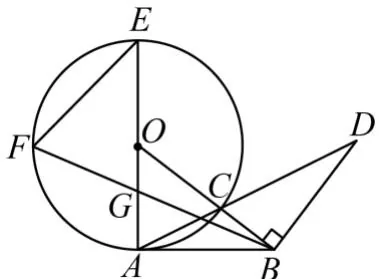
∵ AE 为 □ O 的直径,AB 与 □ O 相切于点 A,
$\therefore OA \perp AB,$
$\therefore \angle OAB = 90^{\circ},$
$$ \therefore \angle O A C + \angle B A D = 9 0 ^ {\circ} $$
$$ \because B D \perp O B, $$
$$ \therefore \angle O B D = 9 0 ^ {\circ} $$
$$ \therefore \angle B C D + \angle D = 9 0 ^ {\circ} $$
$$ \because O A = O C, $$
$$ \therefore \angle O A C = \angle O C A, $$
$$ \because \angle B C D = \angle O C A $$
$\therefore \angle OAC = \angle BCD,$
$\therefore \angle BAD = \angle D,$
$\therefore AB = AD.$
【小问 2 详解】
连接OF,过点D作 $DM\perp AB$ ,交AB延长线于点M,如图,
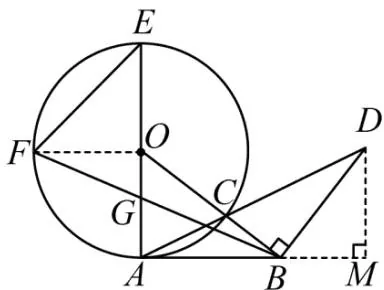
在 Rt△ABG 中, $\angle GAB = 90^{\circ}$ ,
$\therefore \tan \angle ABG = \frac{AG}{AB} = \frac{3}{7}$
$\therefore AG = AB \cdot \tan \angle ABG = \frac{15}{7},$
$$ \because \angle E = 4 5 ^ {\circ} $$
$$ \therefore \angle A O F = 2 \angle E = 9 0 ^ {\circ} $$
$$ \therefore \angle A O F = \angle O A B, $$
$$ \therefore O F \parallel A B, $$
$$ \therefore \angle O F G = \angle A B G $$
$$ \therefore \tan \angle O F G = \tan \angle A B G = \frac {3}{7} $$
设□O的半径为r,
$$ \therefore \frac {r - \frac {1 5}{7}}{r} = \frac {3}{7}, $$
$\therefore r=\frac{15}{4}$ ,
$\therefore \tan \angle OBA = \frac{OA}{AB} = \frac{3}{4}$ ,
$\because DM \perp AB,$
$$ \therefore \angle M = 9 0 ^ {\circ} $$
∴ $\angle BDM + \angle DBM = 90^{\circ}$ , ∵ BD ⊥ OB, ∴ ∠OBD = 90°, ∴ ∠OBA + ∠DBM = 90°, ∴ ∠BDM = ∠OBA, 即 $\tan \angle BDM = \tan \angle OBA = \frac{3}{4}$ , ∴ 设 BM = 3x,DM = 4x, 在 Rt△DBM 中, $\angle M = 90^{\circ}$ , ∵ $BM^{2} + DM^{2} = BD^{2}$ ,BD = AB = 5, ∴ $(3x)^{2} + (4x)^{2} = 5^{2}$ ,解得 x = 1, ∴ BM = 3,DM = 4, ∴ AM = AB + BM = 8, ∴ $AD = \sqrt{AM^{2} + DM^{2}} = 4\sqrt{5}$ .
【点睛】本题考查了圆与三角形的综合问题,解题的关键是熟练掌握圆、三角形的线段、角度关系并运用数学结合思想.
六、解答题(本题共10分)
- 端午节前夕,某批发部购入一批进价为 8 元/袋 粽子,销售过程中发现:日销量 y(袋)与售价 x(元/袋)满足如图所示的一次函数关系.
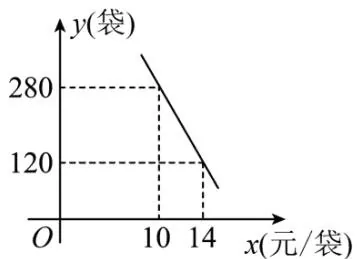
(1) 求 y 与 x 之间的函数关系式;
(2)每袋粽子的售价定为多少元时,所获日销售利润最大,最大日销售利润是多少元?
【答案】(1) $y = -40x + 680$
(2)当粽子的售价定为
12.5 元/袋时,日销售利润最大,最大日销售利润是 810 元
【解析】
【分析】(1)直接应用待定系数法即可求出一次函数解析式;
(2)根据题意列出获日销售利润与 x 的函数关系式,然后利用二次函数的性质即可求解.
【小问 1 详解】
解:设一次函数的解析式为 $y = kx + b$ ,
将 $(10,280)$ , $(14,120)$ 代入得:
$$ { \begin{array}{l} 2 8 0 = 1 0 k + b \ 1 2 0 = 1 4 k + b \end{array} , $$
解得: ${\begin{aligned}k&=-40\ b&=680\end{aligned}$ ,
∴求 y 与 x 之间的函数关系式为 $y = -40x + 680$ ;
【小问 2 详解】
解:设日销售利润为 w,
由题意得: $w=(x-8)y=(x-8)(-40x+680)$
$$ = - 4 0 x ^ {2} + 1 0 0 0 x - 5 4 4 0 $$
$$ = - 4 0 (x - 1
- ^ {2} + 8 1 0,
$$
∴当x=12.5时,w有最大值,最大值为810,
∴当粽子的售价定为
12.5 元/袋时,日销售利润最大,最大日销售利润是 810 元.
【点睛】本题考查了二次函数 应用,二次函数的最值,理解掌握题意,正确的找出题目中的等量关系,列出方程或函数关系式是解题的关键.
七、解答题(本大题共2道题,每题12分,共24分)
- 【问题情境】如图,在□ABC中,AB = AC, $\angle ACB = \alpha$ .点D在边BC上将线段DB绕点D顺时针旋转得到线段DE(旋转角小于180°),连接BE,CE,以CE为底边在其上方作等腰三角形FEC,使 $\angle FCE = \alpha$ ,连接AF.
【尝试探究】
(1)如图 1,当 $\alpha = 60^{\circ}$ 时,易知 AF = BE;
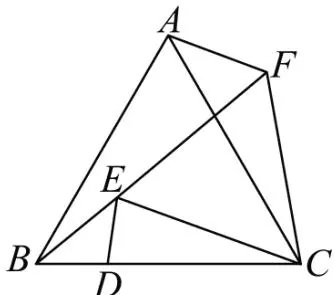 图1
如图 2,当 $\alpha = 45^{\circ}$ 时,则 AF 与 BE 的数量关系为 ____;
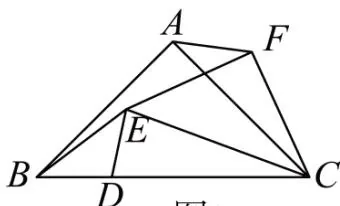 图2
(2)如图 3,写出 AF 与 BE 的数量关系(用含 $\alpha$ 的三角函数表示)。并说明理由;
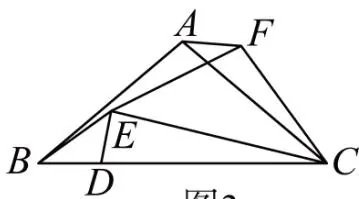 图3
【拓展应用】
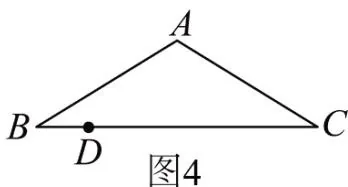
(3)如图 4,当 $\alpha=30^{\circ}$ ,且点 B,E,F 三点共线时.若 $BC=4\sqrt{7}$ , $BD=\frac{1}{5}BC$ ,请直接写出 AF 的长.
【答案】(1) $BE=\sqrt{2}AF$ ;(2) $BE=2\cos\alpha AF$ ,理由见解析;(3) $AF=\frac{4\sqrt{3}}{3}$
【解析】
【分析】(1)先证明 $\triangle ABC \sim \triangle FEC$ ,可得 $\frac{BC}{AC} = \frac{EC}{FC}$ ,再证 $\square BCE \sim \square ACF$ 得出 $\frac{BE}{AF} = \frac{BC}{AC}$ ,利用等腰三角形三线合一的性质得出 BC = 2CH,在 Rt $\square AHC$ 中,利用余弦定义可求 $\cos \angle ACH = \cos \alpha = \frac{CH}{AC}$ ,即可得出 $BE = 2 \cos \alpha AF$ ,然后把 $\alpha = 45^{\circ}$ 代入计算即可;
(2)仿照(1)的思路即可解答;
(3)方法一:如图,过点 D 作 $DM \perp BF$ 于点 M,过点 C 作 $CH \perp BF$ ,交 BF 延长线于点 H,可求 $\angle HCF = 30^{\circ}$ ,得出 FC = FE = 2FH,设 BM = x,则 BE = 2x,利用平行线分线段成比例得出 $\frac{BM}{BH} = \frac{BD}{BC} = \frac{1}{5}$ ,则可求 BH = 5x,EH = 3x,FE = FC = 2x,FH = x, $HC = \sqrt{3}x$ ,在 Rt△BHC 中,利用勾股定理构建方程 $(5x)^{2} + (\sqrt{3}x)^{2} = (4\sqrt{7})^{2}$ ,求出 x = 2。证明 □ BEC ∼ □ AFC,利用相似三角形的性质即可求解;
方法二:如图,过点 C 作 $CG \parallel BF$ 交 $ED$ 延长线于点 G, 过点 D 作 $DM \perp CG$ 于点 M, 过点 E 作 $EH \perp CG$ 于点 H, 利用等腰三角形的性质与判断, 平行线的性质可证明 $DG = DC$ , $GM = CM$ , 证明 $\triangle BDE \sim \triangle CDG$ , 可得出 $\frac{BE}{CG} = \frac{ED}{DG} = \frac{BD}{DC} = \frac{1}{4}$ . 设 $GE = 2x$ , 则 $GC = 8x$ , 设 $GE = 2x$ , 则 $GC = 8x$ , 利用平行线分线段成比例得出 $\frac{HM}{MG} = \frac{ED}{DG} = \frac{1}{4}$ , 求出 $HM = x$ , $HC = 3x$ , $GH = 5x$ , $HE = \sqrt{3}x$ . 然后在 Rt $\triangle EHG$ 中, 利用勾股定理构建方程 $(5x)^{2} + (\sqrt{3}x)^{2} = (4\sqrt{7})^{2}$ , 求出 $x = 2$ , 证明 $\square BEC \sim \square AFC$ , 利用相似三角形的性质即可求解.
【详解】(1)如图,过点 A 作 $AH \perp BC$ 于点 H,
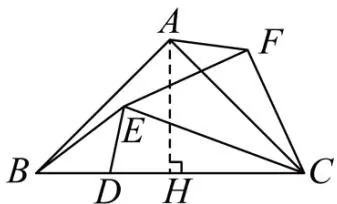
$$ \because A B = A C, \angle A C B = \alpha $$
$$ \therefore \angle A B C = \angle A C B = \alpha $$
$$ \therefore \angle B A C = 1 8 0 ^ {\circ} - 2 \alpha $$
∵□FEC是以CE为底边的等腰三角形,∠FCE=α,
$$ \therefore \angle F E C = \angle F C E = \alpha , \angle A C B = \angle F C E = \alpha $$
$$ \therefore \angle E F C = 1 8 0 ^ {\circ} - 2 \alpha $$
$$ \therefore \angle B A C = \angle E F C $$
$$ \therefore \triangle A B C \sim \triangle F E C $$
$$ \frac {B C}{E C} = \frac {A C}{F C} $$
$$ \therefore \frac {B C}{A C} = \frac {E C}{F C} $$
$$ \because \angle A C B = \angle F C E = \alpha $$
$$ \therefore \angle B C E = \angle A C F $$
$$ \therefore \square B C E \sim \square A C F $$
$$ \therefore \frac {B E}{A F} = \frac {B C}{A C} $$
$\because AB = AC, H$ 为 BC 的中点,
$$ \therefore B C = 2 C H $$
在 Rt□AHC 中, $\angle AHC = 90^{\circ}$ ,
$\therefore \cos \angle ACH = \cos \alpha = \frac{CH}{AC} , .$
$$ \therefore \frac {B E}{A F} = \frac {2 C H}{A C} = 2 \cos \alpha . $$
$$ \therefore B E = 2 \cos \alpha A F $$
又 $\alpha = 45^{\circ}$ ,
$\therefore BE = \sqrt{2}AF;$
(2) 解: $BE = 2\cos \alpha AF$ ;
如图,过点 A 作 $AH \perp BC$ 于点 H,
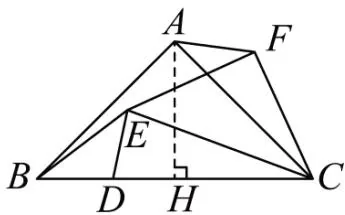
$\because AB = AC, \angle ACB = \alpha,$
$$ \therefore \angle A B C = \angle A C B = \alpha $$
$$ \therefore \angle B A C = 1 8 0 ^ {\circ} - 2 \alpha $$
∵□FEC是以CE为底边的等腰三角形,∠FCE=α,
$$ \therefore \angle F E C = \angle F C E = \alpha , \angle A C B = \angle F C E = \alpha $$
$$ \therefore \angle E F C = 1 8 0 ^ {\circ} - 2 \alpha . $$
$$ \therefore \angle B A C = \angle E F C $$
$\therefore \Delta ABC \sim \Delta FEC.$
$\therefore \frac{BC}{EC}=\frac{AC}{FC}.$
$\therefore \frac{BC}{AC}=\frac{EC}{FC}.$
$$ \because \angle A C B = \angle F C E = \alpha , $$
$$ \therefore \angle B C E = \angle A C F $$
$\therefore \square BCE \sim \square ACF$
$\therefore \frac{BE}{AF}=\frac{BC}{AC}.$
$\because AB = AC, H$ 为 BC 的中点,
$$ \therefore B C = 2 C H. $$
在 Rt□AHC 中, $\angle AHC = 90^{\circ}$ ,
$$ \therefore \cos \angle A C H = \cos \alpha = \frac {C H}{A C}. $$
$$ \therefore \frac {B E}{A F} = \frac {2 C H}{A C} = 2 \cos \alpha . $$
$$ \therefore B E = 2 \cos \alpha A F. $$
(3) $AF = \frac{4\sqrt{3}}{3}$ .
方法一:
如图,过点 D 作 $DM \perp BF$ 于点 M,过点 C 作 $CH \perp BF$ ,交 BF 延长线于点 H,
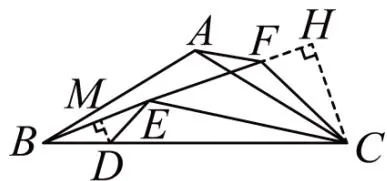
$$ \therefore \angle B M D = \angle H = 9 0 ^ {\circ} $$
$$ \therefore D M \parallel C H. $$
∵线段 DB 绕点 D 顺时针旋转得到线段 DE,
$$ \therefore D B = D E. $$
$$ \therefore B M = E M. $$
∵□FEC是以CE为底边 等腰三角形, $\angle FCE=30^{\circ}$ ,
$$ \therefore F E = F C, \angle F E C = \angle F C E = 3 0 ^ {\circ}. $$
$$ \therefore \angle H F C = \angle F E C + \angle F C E = 6 0 ^ {\circ}. $$
$$ \therefore \angle H C F = 1 8 0 ^ {\circ} - \angle H - \angle H F C = 3 0 ^ {\circ} $$
$\therefore FC = 2FH$
$$ \because F E = F C, $$
$\therefore FE = 2FH$
设 BM = x,则 BE = 2x,
$$ \because D M \parallel C H $$
$$ \therefore \frac {B M}{B H} = \frac {B D}{B C} = \frac {1}{5}, $$
$$ \therefore B H = 5 B M = 5 x. $$
$$ \therefore E H = B H - B E = 3 x. $$
$$ \because F E = 2 F H, $$
$$ \therefore F E = F C = 2 x, F H = x. $$
$$ \therefore H C = \sqrt {3} x. $$
在Rt△BHC中,∠BHC=90°,BC=4√7,
$$ \therefore B H ^ {2} + C H ^ {2} = B C ^ {2} $$
$\therefore (5x)^{2} + (\sqrt{3} x)^{2} = (4\sqrt{7})^{2}$ ,解得 $x = 2$ 。
$$ \therefore B E = 2 x =
$$
$$ \because \square B E C \sim \square A F C, $$
$$ \therefore A F = \frac {\sqrt {3}}{3} B E = \frac {4 \sqrt {3}}{3}. $$
方法二:
如图,过点 C 作 $CG \parallel BF$ 交 ED 延长线于点 G,过点 D 作 $DM \perp CG$ 于点 M,过点 E 作 $EH \perp CG$ 于点 H,
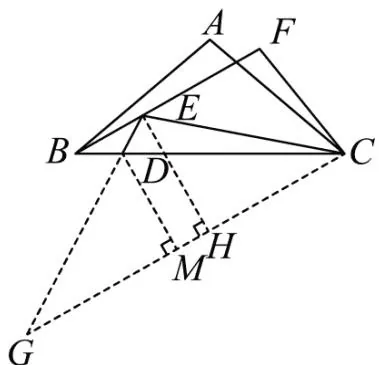
$\therefore \angle DMG = \angle EHG = 90^{\circ}.$
$\therefore DM \parallel EH$ .
∵线段 DB 绕点 D 顺时针旋转得到线段 DE,
$$ \therefore D B = D E. $$
$$ \therefore \angle D B E = \angle D E B. $$
$$ \because C G \parallel B F, $$
$\therefore \angle DBE = \angle DCG, \angle DEB = \angle G.$
$$ \therefore D G = D C. $$
$\because DM \perp CG,$
$$ \therefore G M = C M. $$
∵□FEC是以CE为底边的等腰三角形, $\angle FCE=30^{\circ}$ ,
$$ \therefore \angle F E C = \angle F C E = 3 0 ^ {\circ} $$
$\because CG \parallel BF,$
$\therefore \angle ECG = \angle FEC = 30^{\circ}, \Delta BDE \sim \Delta CDG.$
$$ \therefore \frac {B E}{C G} = \frac {E D}{D G} = \frac {B D}{D C} = \frac {1}{4}. $$
设 GE = 2x,则 GC = 8x,
$$ \because D M \parallel E H, $$
$$ \therefore \frac {H M}{M G} = \frac {E D}{D G} = \frac {1}{4}. $$
$$ \therefore H M = x. $$
$$ \therefore H C = 3 x. $$
$$ \therefore G H = G M + H M = 5 x $$
在Rt△EHC中,∠ECH=30°,
$$ \therefore H E = \sqrt {3} x $$
在Rt△EHG中,∠EHG=90°,GE=BC=4 $\sqrt{7}$ ,
$$ \therefore G H ^ {2} + E H ^ {2} = G E ^ {2}. $$
$\therefore (5x)^{2} + (\sqrt{3} x)^{2} = (4\sqrt{7})^{2}$ ,解得 $x = 2$
$$ \therefore B E = 2 x =
$$
$$ \because \square B E C \sim \square A F C, $$
$$ \therefore A F = \frac {\sqrt {3}}{3} B E = \frac {4 \sqrt {3}}{3}. $$
【点睛】本题考查了相似三角形的判定和性质,等腰三角形的判断与性质,勾股定理,锐角三角函数等知识,解决问题的关键是作辅助线,构造相似三角形.
- 如图,抛物线 $y = -\sqrt{3}x^{2} + bx + c$ 交 x 轴于点 $A(-1,0)$ 和 B,交 y 轴于点 $C(0,3\sqrt{3})$ ,顶点为 D.
备用图
(1)求抛物线的表达式;
(2)若点 E 在第一象限内对称右侧的抛物线上,四边形 ODEB 的面积为 $7\sqrt{3}$ ,求点 E 的坐标;
(3)在(2)的条件下,若点 F 是对称轴上一点,点 H 是坐标平面内一点,在对称轴右侧的抛物线上是否存在点 G,使以 E,F,G,H 为顶点的四边形是菱形,且 $\angle EFG = 60^{\circ}$ ,如果存在,请直接写出点 G 的坐标;如果不存在,请说明理由.
【答案】(1) $y = -\sqrt{3}x^{2} + 2\sqrt{3}x + 3\sqrt{3}$
(2) $E(2,3\sqrt{3})$
(3)存在,点 G 的坐标为 $(\frac{7}{3},\frac{20}{9}\sqrt{3})$ 或 $(\frac{5}{3},\frac{32}{9}\sqrt{3})$
【解析】
【分析】(1)根据待定系数法求解即可;
(2)方法一:连接 DB,过点 E 作 $EP \parallel y$ 轴交 BD 于点 P.先求得直线 BD 的表达式为: $y = -2\sqrt{3}x + 6\sqrt{3}$ .再设 $E(x, -\sqrt{3}x^{2} + 2\sqrt{3}x + 3\sqrt{3})$ , $P(x, -2\sqrt{3}x + 6\sqrt{3})$ ,则 $EP = -\sqrt{3}x^{2} + 4\sqrt{3}x - 3\sqrt{3}$ ,利用面积构造一元二次方程求解即可得解;方法二:令抛物线的对称轴与 x 轴交于点 M,过点 E 作 $EN \perp x$ 轴于点 N,设 $E(x, -\sqrt{3}x^{2} + 2\sqrt{3}x + 3\sqrt{3})$ ,利用面积构造一元二次方程求解即可得解;
(3)如下图,连接 CG,DG,由菱形及等边三角形的性质证明 $\Delta CEG \cong \Delta DEF$ 得$\angle ECG = \angle EDF = 30^{\circ}$ . 从而求得直线 CG 的表达式为: $y = -\frac{\sqrt{3}}{3}x + 3\sqrt{3}$ . 联立方程组求解, 又连接 CG, DG, CF, 证 $\Delta DGE \cong \Delta CFE$ . 得 DG = CF, 又证 $\Delta CDG \cong \Delta CEG$ . 得 $\angle DCG = \angle ECG = 30^{\circ}$ . 进 而求得直线 CG 的表达式为: $y = \frac{\sqrt{3}}{3}x + 3\sqrt{3}$ . 联立方程组求解即可.
【小问 1 详解】
解:∵抛物线 $y = -\sqrt{3}x^{2} + bx + c$ 经过点 $A(-1,0)$ , $C(0,3\sqrt{3})$ ,
$\therefore { \begin{array}{l}-\sqrt{3}-b+c=0\ c=3\sqrt{3} \end{array} $ ,解得 ${ \begin{array}{l}b=2\sqrt{3}\ c=3\sqrt{3} \end{array} $
∴抛物线的表达式为: $y=-\sqrt{3}x^{2}+2\sqrt{3}x+3\sqrt{3}$
【小问 2 详解】
解:方法一:如下图,连接 DB,过点 E 作 $EP \parallel y$ 轴交 BD 于点 P.
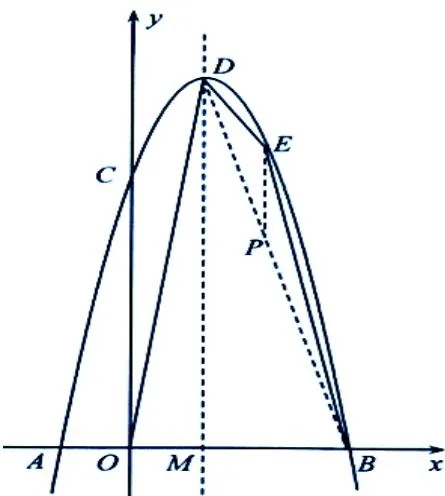
$$ \because y = - \sqrt {3} x ^ {2} + 2 \sqrt {3} x + 3 \sqrt {3} $$
$$ = - \sqrt {3} (x - 1) ^ {2} + 4 \sqrt {3} $$
$$ \therefore D (1, 4 \sqrt {3}) $$
令 $y = -\sqrt{3}x^{2} + 2\sqrt{3}x + 3\sqrt{3}$ 中 y = 0,则 $0 = -\sqrt{3}x^{2} + 2\sqrt{3}x + 3\sqrt{3}$ ,
解得 x = -1 或 x = 3,
$$ \therefore B (3, 0) $$
设直线 BD 为 $y = kx + b$ ,
$\because y=kx+b$ 过点 $D(1,4\sqrt{3})$ , $B(3,0)$ ,(\begin{aligned}&\therefore{\begin{aligned}&4\sqrt{3}=k+b\&0=3k+b\end{aligned},\&\text{解得}{\begin{aligned}&k=-2\sqrt{3}\&b=6\sqrt{3}\end{aligned},\&\therefore\text{直线}BD\text{的表达式为: }y=-2\sqrt{3}x+6\sqrt{3}.\end{aligned}) 设 (E(x,-\sqrt{3}x^{2}+2\sqrt{3}x+3\sqrt{3}),\quad P(x,-2\sqrt{3}x+6\sqrt{3}),) (\therefore EP=-\sqrt{3}x^{2}+2\sqrt{3}x+3\sqrt{3}-(-2\sqrt{3}x+6\sqrt{3})) (=-\sqrt{3}x^{2}+4\sqrt{3}x-3\sqrt{3}.) (\therefore S_{\text{四边形}ODEB}=S_{\triangle OBD}+S_{\triangle EBD}) (=\frac{1}{2}OB\cdot y_{D}+\frac{1}{2}EP\cdot(x_{B}-x_{D})) (=\frac{1}{2}\times3\times4\sqrt{3}+\frac{1}{2}(-\sqrt{3}x^{2}+4\sqrt{3}x-3\sqrt{3})\cdot2) (=-\sqrt{3}x^{2}+4\sqrt{3}x+3\sqrt{3}.) (\because S_{\text{四边形}ODEB}=7\sqrt{3},) (\therefore-\sqrt{3}x^{2}+4\sqrt{3}x+3\sqrt{3}=7\sqrt{3}.) 整理得 (x^{2}-4x+4=0), 解得 (x_{1}=x_{2}=2). (\therefore E(2,3\sqrt{3}).) (\therefore E(2,3\sqrt{3}).) (\therefore E(2,3\sqrt{3}).) (\therefore E(2,3\sqrt{3}).) (\therefore E(2,3\sqrt{3}).) (\therefore E(2,3\sqrt{3}).) (\therefore E(2,3\sqrt{3}).) (\therefore E(2,3\sqrt{3}).) (\therefore E(2,3\sqrt{3}).) (\therefore E(2,3\sqrt{3}).) (\therefore E(2,3\sqrt{3}).) (\therefore E(2,3\sqrt{3}).) (\therefore E(2,3\sqrt{3}).) (\therefore E(2,3\sqrt{3}).) (\therefore E(2,3\sqrt{3}).) (\therefore E(2,3\sqrt{3}).) (\therefore E(2,3\sqrt{3}).) (\therefore E(2,3\sqrt{3}).) (\therefore E(2,3\sqrt{3}).) (\therefore E(2,3\sqrt{3}).) (\therefore E(2,3\sqrt{3}).) (\therefore E(2,3\sqrt{3}).) (\therefore E(2,3\sqrt{3}).) (\therefore E(2,3\sqrt{3}).) (\therefore E(2,3\sqrt{3}).) (\therefore E(2,3\sqrt{3}).) (\therefore E(2,3\sqrt{3}).) (\therefore E(2,3\sqrt{3}).) (\therefore E(2,3\sqrt{3}).) (\therefore E(2,3\sqrt{3}).) (\therefore E(2,3\sqrt{3}).) (\therefore E(2,3\sqrt{3}).) (\therefore E(2,3\sqrt{3}).) (\therefore E(2,3\sqrt{3}).) (\therefore E(2,3\sqrt{3}).) (\therefore E(2,3\sqrt{3}).) (\therefore E(2,3\sqrt{3}).) (\therefore E(2,3\sqrt{3}).) (\therefore E(2,3\sqrt{3}).) (\therefore E(2,3\sqrt{3}).) (\therefore E(2,3\sqrt{3}).) (\therefore E(2,3\sqrt{3}).) (\therefore E(2,3\sqrt{3}).) (\therefore E(2,3\sqrt{3}).) (\therefore E(2,3\sqrt{3}).) (\therefore E(2,3\sqrt{3}).) (\therefore E(2,3\sqrt{3}).) (\therefore E(2,3\sqrt{3}).) (\therefore E(2,3\sqrt{3}).) (\therefore E(2,3\sqrt{3}).) (\therefore E(2,3\sqrt{3}).) (\therefore E(2,3\sqrt{3}).) (\therefore E(2,3\sqrt{3}).) (\therefore E(2,3\sqrt{3}).) (\therefore E(2,3\sqrt{3}).) (\therefore E(2,3\sqrt{3}).) (\therefore E(2,3\sqrt{3}).) (\therefore E(2,3\sqrt{3}).) (\therefore E(2,3\sqrt{3}).) (\therefore E(2,3\sqrt{3}).) (\therefore E(2,3\sqrt{3}).) (\therefore E(2,3\sqrt{3}).) (\therefore E(2,3\sqrt{3}).) (\therefore E(2,3\sqrt{3}).) (\therefore E(2,3\sqrt{3}).) (\therefore E(2,3\sqrt{3}).) (\therefore E(2,3\sqrt{3}).) (\therefore E(2,3\sqrt{3}).) (\therefore E(2,3\sqrt{3}).) (\therefore E(2,3\sqrt{3}).) (\therefore E(2,3\sqrt{3}).) (\therefore E(2,3\sqrt{3}).) (\therefore E(2,3\sqrt{3}).) (\therefore E(2,3\sqrt{3}).) (\therefore E(2,3\sqrt{3}).) (\therefore E(2,3\sqrt{3}).) (\therefore E(2,3\sqrt{3}).) (\therefore E(2,3\sqrt{3}).) (\therefore E(2,3\sqrt{3}).) (\therefore E(2,3\sqrt{3}).) (\therefore E(2,3\sqrt{3}).) (\therefore E(2,3\sqrt{3}).) (\therefore E(2,3\sqrt{3}).) (\therefore E(2,3\sqrt{3}).) (\therefore E(2,3\sqrt{3}).) (\therefore E(2,3\sqrt{3}).) (\therefore E(2,3\sqrt{3}).) (\therefore E(2,3\sqrt{3}).) (\therefore E(2,3\sqrt{3}).) (\therefore E(2,3\sqrt{3}).) (\therefore E(2,3\sqrt{3}).) (\therefore E(2,3\sqrt{3}).) (\therefore E(2,3\sqrt{3}).) (\therefore E(2,3\sqrt{3}).) (\therefore E(2,3\sqrt{3}).) (\therefore E(2,3\sqrt{3}).) (\therefore E(2,3\sqrt{3}).) (\therefore E(2,3\sqrt{3}).) (\therefore E(2,3\sqrt{3}).) (\therefore E(2,3\sqrt{3}).) (\therefore E(2,3\sqrt{3}).) (\therefore E(2,3\sqrt{3}).) (\therefore E(2,3\sqrt{3}).) (\therefore E(2,3\sqrt{3}).) (\therefore E(2,3\sqrt{3}).) (\therefore E(2,3\sqrt{3}).) (\therefore E(2,3\sqrt{3}).) (\therefore E(2,3\sqrt{3}).) (\therefore E(2,3\sqrt{3}).) (\therefore E(2,3\sqrt{3}).) (\therefore E(2,3\sqrt{3}).) (\therefore E(2,3\sqrt{3}).) (\therefore E(2,3\sqrt{3}).) (\therefore E(2,3\sqrt{3}).) (\therefore E(2,3\sqrt{3}).) (\therefore E(2,3\sqrt{3}).) (\therefore E(2,3\sqrt{3}).) (\therefore E(2,3\sqrt{3}).) (\therefore E(2,3\sqrt{3}).) (\therefore E(2,3\sqrt{3}).) (\therefore E(2,3\sqrt{3}).) (\therefore E(2,3\sqrt{3}).) (\therefore E(2,3\sqrt{3}).) (\therefore E(2,3\sqrt{3}).) (\therefore E(2,3\sqrt{3}).) (\therefore E(2,3\sqrt{3}).) (\therefore E(2,3\sqrt{3}).) (\therefore E(2,3\sqrt{3}).) (\therefore E(2,3\sqrt{3}).) (\therefore E(2,3\sqrt{3}).) (\therefore E(2,3\sqrt{3}).) (\therefore E(2,3\sqrt{3}).) (\therefore E(2,3\sqrt{3}).) (\therefore E(2,3\sqrt{3}).) (\therefore E(2,3\sqrt{3}).) (\therefore E(2,3\sqrt{3}).) (\therefore E(2,3\sqrt{3}).) (\therefore E(2,3\sqrt{3}).) (\therefore E(2,3\sqrt{3}).) (\therefore E(2,3\sqrt{3}).) (\therefore E(2,3\sqrt{3}).) (\therefore E(2,3\sqrt{3}).) (\therefore E(2,3\sqrt{3}).) (\therefore E(2,3\sqrt{3}).) (\therefore E(2,3\sqrt{3}).) (\therefore E(2,3\sqrt{3}).) (\therefore E(2,3\sqrt{3}).) (\therefore E(2,3\sqrt{3}).) (\therefore E(2,3\sqrt{3}).) (\therefore E(2,3\sqrt{3}).) (\therefore E(2,3\sqrt{3}) (\therefore E(2,3\sqrt{3}) (\therefore E(2,3\sqrt{3}) (\therefore E(2,3\sqrt{3}) (\therefore E(2,3\sqrt{3}) (\therefore E(2,3\sqrt{3}) (\therefore E(2,3\sqrt{3}) (\therefore E(2,3\sqrt{3}) (\therefore E(2,3\sqrt{3}) (\therefore E(2,3\sqrt{3}) (\therefore E(2,3\sqrt{3}) (\therefore E(2,3\sqrt{3}) (\therefore E(2,3\sqrt{3}) (\therefore E(2,3\sqrt{3}) (\therefore E(2,3\sqrt{3}) (\therefore E(2,3\sqrt{3}) (\therefore E(2,3\sqrt{3}) (\therefore E(2,3\sqrt{3}) (\therefore E(2,3\sqrt{3}) (\therefore E(2,3\sqrt{3}) (\therefore E(2,3\sqrt{3}) (\therefore E(2,3\sqrt{3}) (\therefore E(2,3\sqrt{3}) (\therefore E(2,3\sqrt{3}) (\therefore E(2,3\sqrt{3}) (\therefore E(2,3\sqrt{3}) (\therefore E(2,3\sqrt{3}) (\therefore E(2,3\sqrt{3}) (\therefore E(2,3\sqrt{3}) (\therefore E(2,3\sqrt{3}) (\therefore E(2,3\sqrt{3}) (\therefore E(2,3\sqrt{3}) (\therefore E(2,3\sqrt{3}) (\therefore E(2,3\sqrt{3}) (\therefore E(2,3\sqrt{3}) (\therefore E(2,3\sqrt{3}) (\therefore E(2,3\sqrt{3}) (\therefore E(2,3\sqrt{3}) (\therefore E(2,3\sqrt{3}) (\therefore E(2,3\sqrt{3}) (\therefore E(2,3\sqrt{3}) (\therefore E(2,3\sqrt{3}) (\therefore E(2,3\sqrt{3}) (\therefore E(2,3\sqrt{3}) (\therefore E(2,3\sqrt{3}) (\therefore E(2,3\sqrt{3}) (\therefore E(2,3\sqrt{3}) (\therefore E(2,3\sqrt{3}) (\therefore E(2,3\sqrt{3}) (\therefore E(2,3\sqrt{3}) (\therefore E(2,3\sqrt{3}) (\therefore E(2,3\sqrt{3}) (\therefore E(2,3\sqrt{3}) (\therefore E(2,3\sqrt{3}) (\therefore E(2,3\sqrt{3}) (\therefore E(2,3\sqrt{3}) (\therefore E(2,3\sqrt{3}) (\therefore E(2,3\sqrt{3}) (\therefore E(2,3\sqrt{3}) (\therefore E(2,3\sqrt{3}) (\therefore E(2,3\sqrt{3}) (\therefore E(2,3\sqrt{3}) (\therefore E(2,3\sqrt{3}) (\therefore E(2,3\sqrt{3}) (\therefore E(2,3\sqrt{3}) (\therefore E(2,3\sqrt{3}) (\therefore E(2,3\sqrt{3}) (\therefore E(2,3\sqrt{3}) (\therefore E(2,3\sqrt{3}) (\therefore E(2,3\sqrt{3}) (\therefore E(2,3\sqrt{3}) (\therefore E(2,3\sqrt{3}) (\therefore E(2,3\sqrt{3}) (\therefore E(2,3\sqrt{3}) (\therefore E(2,3\sqrt{3}) (\therefore E(2,3\sqrt{3}) (\therefore E(2,3\sqrt{3}) (\therefore E(2,3\sqrt{3}) (\therefore E(2,3\sqrt{3}) (\therefore E(2,3\sqrt{3}) (\therefore E(2,3\sqrt{3}) (\therefore E(2,3\sqrt{3}) (\therefore E(2,3\sqrt{3}) (\therefore E(2,3\sqrt{3}) (\therefore E(2,3\sqrt{3}) (\therefore E(2,3\sqrt{3}) (\therefore E(2,3\sqrt{3}) (\therefore E(2,3\sqrt{3}) (\therefore E(2,3\sqrt{3}) (\therefore E(2,3\sqrt{3}) (\therefore E(2,3\sqrt{3}) (\therefore E(2,3\sqrt{3}) (\therefore E(2,3\sqrt{3}) (\therefore E(2,3\sqrt{3}) (\therefore E(2,3\sqrt{3}) (\therefore E(2,3\sqrt{3}) (\therefore E(2,3\sqrt{3}) (\therefore E(2,3\sqrt{3}) (\therefore E(2,3\sqrt{3}) (\therefore E(2,3\sqrt{3}) (\therefore E(2,3\sqrt{3}) (\therefore E(2,3\sqrt{3}) (\therefore E(2,3\sqrt{3}) (\therefore E(2,3\sqrt{3}) (\therefore E(2,3\sqrt{3}) (\therefore E(2,3\sqrt{3}) (\therefore E(2,3\sqrt{3}) (\therefore E(2,3\sqrt{3}) (\therefore E(2,3\sqrt{3}) (\therefore E(2,3\sqrt{3}) (\therefore E(2,3\sqrt{3}) (\therefore E(2,3\sqrt{3}) (\therefore E(2,3\sqrt{3}) (\therefore E(2,3\sqrt{3}) (\therefore E(2,3\sqrt{3}) (\therefore E(2,3\sqrt{3}) (\therefore E(2,3\sqrt{3}) (\therefore E(2,3\sqrt{3}) (\therefore E(2,3\sqrt{3}) (\therefore E(2,3\sqrt{3}) (\therefore E(2,3\sqrt{3}) (\therefore E(2,3\sqrt{3}) (\therefore E(2,3\sqrt{3}) (\therefore E(2,3\sqrt{3}) (\therefore E(2,3\sqrt{3}) (\therefore E(2,3\sqrt{3}) (\therefore E(2,3\sqrt{3}) (\therefore E(2,3\sqrt{3}) (\therefore E(2,3\sqrt{3}) (\therefore E(2,3\sqrt{3}) (\therefore E(2,3\sqrt{3}) (\therefore E(2,3\sqrt{3}) (\therefore E(2,3\sqrt{3}) (\therefore E(2,3\sqrt{3}) (\therefore E(2,3\sqrt{3}) (\therefore E(2,3\sqrt{3}) (\therefore E(2,3\sqrt{3}) (\therefore E(2,3\sqrt{3}) (\therefore E(2,3\sqrt{3}) (\therefore E(2,3\sqrt{3}) (\therefore E(2,3\sqrt{3}) (\therefore E(2,3\sqrt{3}) (\therefore E(2,3\sqrt{3}) (\therefore E(2,3\sqrt{3}) (\therefore E(2,3\sqrt{3}) (\therefore E(2,3\sqrt{3}) (\therefore E(2,3\sqrt{3}) (\therefore E(2,3\sqrt{3}) (\therefore E(2,3\sqrt{3}) (\therefore E(2,3\sqrt{3}) (\therefore E(2,3\sqrt{3}) (\therefore E(2,3\sqrt{3}) (\therefore E(2,3\sqrt{3}) (\therefore E(2,3\sqrt{3}) (\therefore E(2,3\sqrt{3}) (\therefore E(2,3\sqrt{3}) (\therefore E(2,3\sqrt{3}) (\therefore E(2,3\sqrt{3}) (\therefore E(2,3\sqrt{3}) (\therefore E(2,3\sqrt{3}) (\therefore E(2,3\sqrt{3}) (\therefore E(2,3\sqrt{3}) (\therefore E(2,3\sqrt{3}) (\therefore E(2,3\sqrt{3}) (\therefore E(2,3\sqrt{3}) (\therefore E(2,3\sqrt{3}) (\therefore E(2,3\sqrt{3}) (\therefore E(2,3\sqrt{3}) (\therefore E(2,3\sqrt{3}) (\therefore E(2,3\sqrt{3}) (\therefore E(2,3\sqrt{3}) (\therefore E(2,3\sqrt{3}) (\therefore E(2,3\sqrt{3}) (\therefore E(2,3\sqrt{3}) (\therefore E(2,3\sqrt{3}) (\therefore E(2,3\sqrt{3}) (\therefore E(2,3\sqrt{3}) (\therefore E(2,3\sqrt{3}) (\therefore E(2,3\sqrt{3}) (\therefore E(2,3\sqrt{3}) (\therefore E(2,3\sqrt{3}) (\therefore E(2,3\sqrt{3}) (\therefore E(2,3\sqrt{3}) (\therefore E(2,3\sqrt{3}) (\therefore E(2,3\sqrt{3}) (\therefore E
方法二:
如下图,
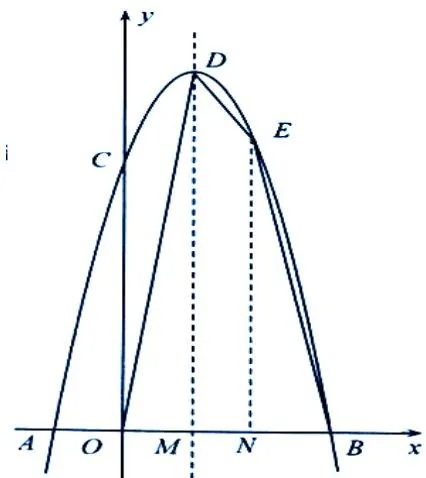
抛物线的对称轴与x轴交于点M,过点E作EN⊥x轴于点N, 设 $E(x,-\sqrt{3}x^{2}+2\sqrt{3}x+3\sqrt{3})$ , ∴ BN = 3 - x,MN = x - 1 ∴ $S_{四边形ODEB} = S_{\Delta ODM} + S_{梯形DMNE} + S_{\Delta ENB}$ $=\frac{1}{2}\times1\times4\sqrt{3}+\frac{1}{2}\cdot(4\sqrt{3}-\sqrt{3}x^{2}+4\sqrt{3}x+3\sqrt{3})(x-1)+\frac{1}{2}(-\sqrt{3}x^{2}+2\sqrt{3}x+3\sqrt{3})\cdot(3-x)$ $=-\sqrt{3}x^{2}+4\sqrt{3}x+3\sqrt{3}$ ∴ $S_{四边形ODEB}=7\sqrt{3}$ ∴ $-\sqrt{3}x^{2}+4\sqrt{3}x+3\sqrt{3}=7\sqrt{3}$ 整理得 $x^{2}-4x+4=0$ ,解得 $x_{1}=x_{2}=2$ 。 ∴ $E(2,3\sqrt{3})$ . 【小问3详解】 解:存在,点G的坐标为 $(\frac{7}{3},\frac{20}{9}\sqrt{3})$ 或 $(\frac{5}{3},\frac{32}{9}\sqrt{3})$ .
如下图,连接CG,DG,
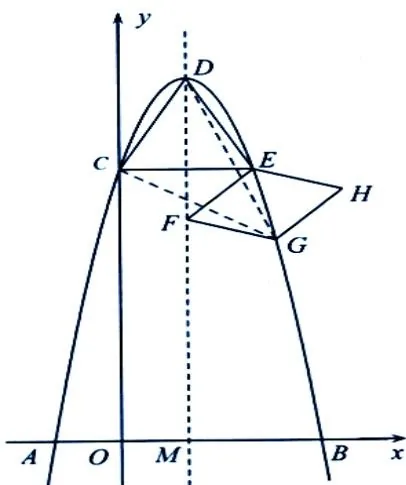
∵四边形 EFGH 是菱形, $\angle EFG = 60^{\circ}$ , ∴ EF = FG = GH = EG, ∵ $\angle EFG = 60^{\circ}$ , ∴ □EFG 是等边三角形. ∴ $\angle FEG = 60^{\circ}$ , EF = FG,
$\because E(2,3\sqrt{3}), C(0,3\sqrt{3}), D(1,4\sqrt{3}),$ $\therefore CE=2, CD=\sqrt{(4\sqrt{3}-3\sqrt{3})^2+1^2}=2, DE=\sqrt{(4\sqrt{3}-3\sqrt{3})^2+(2-1)^2}=2$ , 点 $C$ 与点 $E$ 关于对称轴 $x=1$ 对称, $\therefore CE=CD=DE, DF \square CE,$ $\therefore \triangle DCE$ 是等边三角形, $\angle EDF=\frac{1}{2}\angle CDE,$ $\therefore \angle CED=\angle FEG=\angle CDE=60^\circ,$ $\therefore \angle CED+\angle CEF=\angle FEG+\angle CEF$ 即 $\angle DEF=\angle CEG, \angle EDF=30^\circ,$ $\therefore \triangle CEG \cong \triangle DEF.$ $\therefore \angle ECG=\angle EDF=30^\circ.$ $\therefore$ 直线 $CG$ 的表达式为: $y=-\frac{\sqrt{3}}{3}x+3\sqrt{3}.$ 与抛物线表达式联立得 $\begin{cases} y=-\frac{\sqrt{3}}{3}x+3\sqrt{3} \ y=-\sqrt{3}x^2+2\sqrt{3}x+3\sqrt{3} \end{cases}.$ $\therefore$ 点 $G$ 坐标为 $(\frac{7}{3}, \frac{20}{9}\sqrt{3})$ . 如下图, 连接 $CG, DG, CF$ ,
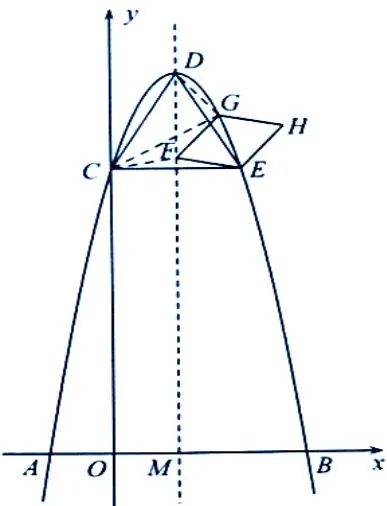
同理可证:□EFG是等边三角形,△DCE是等边三角形,△DGE≌△CFE. ∴ DG = CF, ∵ CF = FE,GE = FE, ∴ DG = GE. ∴ ΔCDG ≌ ΔCEG.
$$ \therefore \angle D C G = \angle E C G = 3 0 ^ {\circ} $$
∴直线CG的表达式为: $y=\frac{\sqrt{3}}{3}x+3\sqrt{3}$
与抛物线表达式联立得 ${\begin{aligned}y&=\frac{\sqrt{3}}{3}x+3\sqrt{3}\ y&=-\sqrt{3}x^{2}+2\sqrt{3}x+3\sqrt{3}\end{aligned}$
∴点G坐标为 $(\frac{5}{3},\frac{32}{9}\sqrt{3})$ .
【点睛】本题主要考查了二次函数的图像及性质,菱形的性质,等边三角形的判定及性质,待定系数法求一次函数与二次函数的解析式,一元二次方程的应用,解二元一次方程组,熟练掌握二次函数的图像及性质,菱形的性质,等边三角形的判定及性质,待定系数法求一次函数与二次函数的解析式是解题的关键.
离线资料
现有试卷附件
请先查看上方试题、答案和解析状态,再按需要下载附件。